Amplify-Now

The Enterprise Execution Guide: How to Connect Initiatives and Protect Enterprise Value

Most organizations lose value not because initiatives fail, but because they are not connected.

Enterprise value is created through value chains — sequences of interdependent work that span functions, teams, and programs. Without visibility into these connections, organizations struggle to manage dependencies, prioritize effectively, or intervene early.

Amplify provides a connected enterprise execution layer, linking strategy, delivery, and value so organizations can see where value is at risk and act before it is lost.

The Hidden Source of Value Loss

In many organizations, transformation execution appears to be improving. Initiatives are better defined, governance is more structured, and delivery is increasingly predictable. From a program or portfolio perspective, this reflects real progress.

Yet despite this, value realization often falls short of expectations. The issue is not typically within individual initiatives. More often, it sits between them — in the dependencies, sequencing decisions, and cross-functional handoffs that determine how work actually progresses across the enterprise.

These interconnections form what can be described as value chains. They cut across functions, teams, and programs, linking work together in ways that are rarely fully visible. It is within these chains that value is either accelerated or constrained. When they are not understood, organizations continue to improve execution locally, while value continues to erode systemically.

Why Traditional Approaches Fall Short

Most tools and operating models are designed around discrete units of work. They provide visibility into initiative status, milestones, and delivery progress, which is necessary for managing execution at a program level. However, they do not provide a clear view of how work connects across the enterprise.

As a result, critical questions remain difficult to answer. Leaders may understand whether an initiative is on track, but not whether it is dependent on another piece of work that is delayed. They may see delivery progress, but not the cumulative impact of sequencing decisions or resource constraints across the portfolio.

This creates a structural limitation. Decisions are made based on partial visibility, and by the time dependencies or conflicts become clear, the opportunity to intervene has often passed. What appears as a delivery issue is, in reality, a visibility problem.

From Initiatives to Value Chains

More mature organizations begin to shift how they view execution. Rather than managing initiatives as isolated investments, they focus on how those initiatives connect to deliver outcomes. This requires understanding not just what work is being done, but how it flows across the organization.

In practice, this means identifying the dependencies that link initiatives together, understanding how sequencing affects outcomes, and recognizing where constraints are likely to emerge. It also means acknowledging that some of the most critical work in a transformation may not sit within high-value initiatives, but in the enablers and cross-functional activities that allow those initiatives to succeed.

This shift changes the focus of execution. Progress is no longer measured solely by delivery milestones, but by how effectively value moves through the system.

“When [value chains] are not understood, organizations continue to improve execution locally, while value continues to erode systemically.”

The Role of an Enterprise Execution Layer

Enabling this shift requires more than improved reporting. It requires a connected enterprise execution layer that brings together strategy, delivery, and value into a single system.

Amplify is designed to provide this layer. It connects strategic priorities to initiatives, links initiatives to measurable outcomes, and makes dependencies visible across functions and teams. This creates a coherent view of execution that extends beyond individual programs and reflects how work actually operates across the enterprise.

By integrating governance, delivery, and value tracking within the same environment, Amplify allows organizations to move beyond fragmented tooling and disconnected reporting. Instead of assembling a view of execution from multiple sources, leaders can see how decisions, dependencies, and performance interact in real time.

Making Dependencies Visible and Actionable

One of the most significant advantages of a connected execution layer is the ability to make dependencies explicit. In many organizations, dependencies are known at a local level but are not consistently surfaced or managed across the portfolio. This creates risk, particularly when delays in one area begin to impact outcomes elsewhere.

Amplify addresses this by making cross-functional dependencies visible within the context of the value chain. This allows organizations to see not just where work is progressing, but where it is being constrained. More importantly, it enables leaders to understand which constraints matter most — and where intervention will have the greatest impact on value realization.

This represents a shift from monitoring activity to managing flow. Rather than focusing on whether work is progressing, the focus moves to whether value is moving through the system as intended.

Supporting Enterprise Execution at Every Level

Enterprise execution is not delivered by a single team. It is the result of coordinated effort across a wide range of participants, each with different responsibilities and perspectives.

For this reason, visibility must be both comprehensive and contextual. Executives require a clear view of value, risk, and progress at an enterprise level. Transformation leaders need to understand portfolio performance, dependencies, and bottlenecks. Initiative owners need clarity on their own delivery, as well as an understanding of what may be impacting it.

Amplify supports this through role-based views that provide relevant insight to each participant while maintaining a shared understanding of how work connects across the system. This ensures that enterprise execution is not only visible at the top, but actionable throughout the organization.

“The challenge for most organizations is not a lack of execution capability, but a lack of visibility into how execution operates as a system.”

From Activity Tracking to Value Management

With this level of visibility in place, organizations are able to shift how they manage execution. The focus moves away from tracking activity and toward managing value.

This means identifying where value is at risk, understanding the drivers of delay, and prioritizing interventions based on their potential impact. It also enables more informed trade-offs, as leaders can see how decisions in one area affect outcomes elsewhere.

Over time, this creates a more deliberate approach to execution. Rather than reacting to issues as they emerge, organizations are able to anticipate constraints and act earlier, protecting value before it is lost.

A More Connected Model of Execution

When strategy, execution, and value are disconnected, fragmentation is inevitable. Teams operate within their own domains, decisions are made with limited visibility, and value is lost in the gaps between initiatives.

By contrast, a connected enterprise execution layer enables a more integrated model. Work is no longer managed as a collection of independent initiatives, but as a system of interdependent activities that must be coordinated to deliver outcomes.

This does not eliminate complexity, but it makes it visible and manageable. And in doing so, it creates the conditions for more consistent and scalable value realization.

From Fragmentation to Enterprise Execution

Enterprise value is not created in isolation. It emerges from how work connects across the organization — through the dependencies, sequencing, and interactions that shape how outcomes are delivered.

The challenge for most organizations is not a lack of execution capability, but a lack of visibility into how execution operates as a system. Without that visibility, dependencies remain hidden, delays compound, and value is lost in the gaps between initiatives.

This is the problem Amplify is designed to solve. By providing a connected enterprise execution layer, Amplify makes value chains visible, exposes dependencies across functions, and links delivery directly to outcomes. It enables organizations to see where value is at risk, understand the impact of delay, and intervene earlier — before that value is lost.

In this model, enterprise execution becomes more than coordination. It becomes a system that can be actively managed and continuously optimized — not just for delivery, but for value realization.

And that is the shift: from managing initiatives in isolation to managing how value flows across the enterprise.

If you are looking to move beyond managing initiatives and start managing how value flows across your organization, Amplify provides the enterprise execution layer to make that possible. Book a demo to see how Amplify connects strategy, execution, and value in a single system — and how it helps you identify and protect value across your transformation portfolio.

From Cost Reduction Programs to Value Creation Portfolios

What this article covers

  • Why leading enterprises are shifting from cost reduction programs to value creation portfolios
  • How transformation leaders balance margin improvement with growth investment
  • The capabilities required to manage trade-offs across transformation initiatives
  • How platforms like Amplify enable portfolio visibility, prioritization, and value realization

From Cost Reduction Programs to Value Creation

For many years, transformation programs were framed primarily around cost reduction. Organizations launched operational efficiency initiatives, restructuring programs, or cost-out exercises designed to improve margins quickly. Consulting firms built extensive practices around these approaches, often focusing on short-term operational improvements and turnaround initiatives.

While these programs can deliver meaningful results, they rarely provide a complete answer to the broader challenge organizations face today. Reducing costs alone does not create sustainable enterprise value. At best, it improves margins temporarily. At worst, it removes capabilities that are critical for long-term growth.

Today, leadership teams face a more complex challenge: how to balance cost savings with investment in future growth.

Leading organizations increasingly recognize that transformation must be framed around value creation, not simply cost reduction. Value creation includes a much broader set of initiatives, such as launching new products, entering new markets, improving customer experience, acquiring capabilities through M&A, and modernizing operating models and technology platforms.

In this model, cost discipline still plays an important role. However, it becomes a means of funding strategic investment, rather than the primary objective of transformation itself.

Why Organizations Struggle to Balance Efficiency and Growth

Despite this shift in thinking, many leadership teams continue to treat cost and growth as competing priorities. Operational efficiency programs are often managed separately from growth initiatives, with different leadership sponsors, reporting structures, and governance processes.

As a result, organizations frequently struggle to answer a fundamental question: where should capital and resources be allocated to create the most value?

Without a clear portfolio view, transformation decisions often become reactive. Initiatives continue because they were approved during a previous planning cycle, while new projects are introduced without fully understanding their impact on the broader portfolio.

Over time, this leads to a familiar pattern. The number of initiatives increases, resources become stretched, and leadership teams lose visibility into which programs are actually driving enterprise value.

Managing Transformation as a Value Creation Portfolio

Execution-mature organizations approach transformation differently. Rather than managing isolated programs, they treat transformation as a portfolio of value creation initiatives aligned to strategic and financial outcomes.

Within this portfolio, initiatives typically fall into several categories. Some focus on operational efficiency and margin expansion. Others invest in growth opportunities, such as new products, services, or markets. Still others build foundational capabilities that enable long-term competitive advantage, including data platforms, digital infrastructure, or new operating models.

Managing these initiatives as a unified portfolio allows leadership teams to evaluate trade-offs more effectively. Cost savings in one part of the organization can be reinvested into growth initiatives elsewhere. Underperforming programs can be paused or stopped, freeing resources for higher-value opportunities. New initiatives can be introduced with a clear understanding of how they affect the broader transformation portfolio.

This approach fundamentally changes how transformation is managed. Instead of simply delivering projects, leadership teams actively manage a portfolio of investments designed to create enterprise value.

“Execution-mature organizations approach transformation differently. Rather than managing isolated programs, they treat transformation as a portfolio of value creation initiatives aligned to strategic and financial outcomes.”

The Capabilities Required to Manage Trade-Offs

Managing this balance between efficiency and growth requires more than intuition alone. It requires structured portfolio visibility and better information to support leadership judgment.

First, initiatives must be clearly aligned with strategic objectives and financial outcomes. Leaders need visibility into how each initiative contributes to enterprise goals and expected value.

Second, organizations require robust prioritization frameworks that allow them to compare initiatives based on expected benefits, resource requirements, and strategic importance.

Third, leadership teams must be able to model scenarios and understand how changes across the portfolio—such as delays, cost increases, or new investment opportunities—affect overall outcomes.

Finally, organizations need mechanisms for tracking value realization as initiatives progress, ensuring that projected benefits translate into measurable financial and operational results.

Without these capabilities, portfolio decisions are often made with incomplete information, making it difficult to manage trade-offs deliberately.

Enabling Portfolio Execution

Many organizations attempt to manage transformation portfolios using spreadsheets, presentation decks, and traditional project management tools. While these approaches may work in the early stages of transformation, they rarely scale effectively as portfolios become more complex.

Amplify provides the structural foundation required to manage transformation portfolios at scale. By connecting strategy, initiatives, financial outcomes, and governance workflows within a single system, organizations gain the visibility needed to evaluate trade-offs and prioritize initiatives effectively.

Leaders can see how initiatives align to enterprise goals, track expected and realized value, and understand how changes across the portfolio impact overall outcomes. Finance teams can participate directly in governance processes, ensuring that capital allocation decisions remain aligned with financial targets.

This level of transparency enables organizations to move beyond reactive program management toward deliberate portfolio execution.

The Bottom Line

Cost reduction and growth investment are not competing strategies. They are complementary levers within a broader value creation portfolio.

Organizations that can see their transformation initiatives clearly, evaluate trade-offs deliberately, and continuously reallocate resources will outperform those that cannot.

As transformation becomes a permanent feature of modern enterprises, the ability to manage a portfolio of strategic initiatives aligned to enterprise value becomes a core leadership capability.

See How Amplify Supports Portfolio Execution

Amplify helps organizations manage transformation as a value creation portfolio, connecting strategy, initiatives, financial outcomes, and governance decisions within a single execution platform.

By providing real-time portfolio visibility, prioritization frameworks, and value realization tracking, Amplify enables leadership teams to allocate capital, capacity, and attention to the initiatives that create the most impact.

Book a demo to see how Amplify supports strategy execution and value realization across your transformation portfolio.

Benefits Realization in Practice: Preventing Value Erosion Across the Transformation Lifecycle

What this article covers

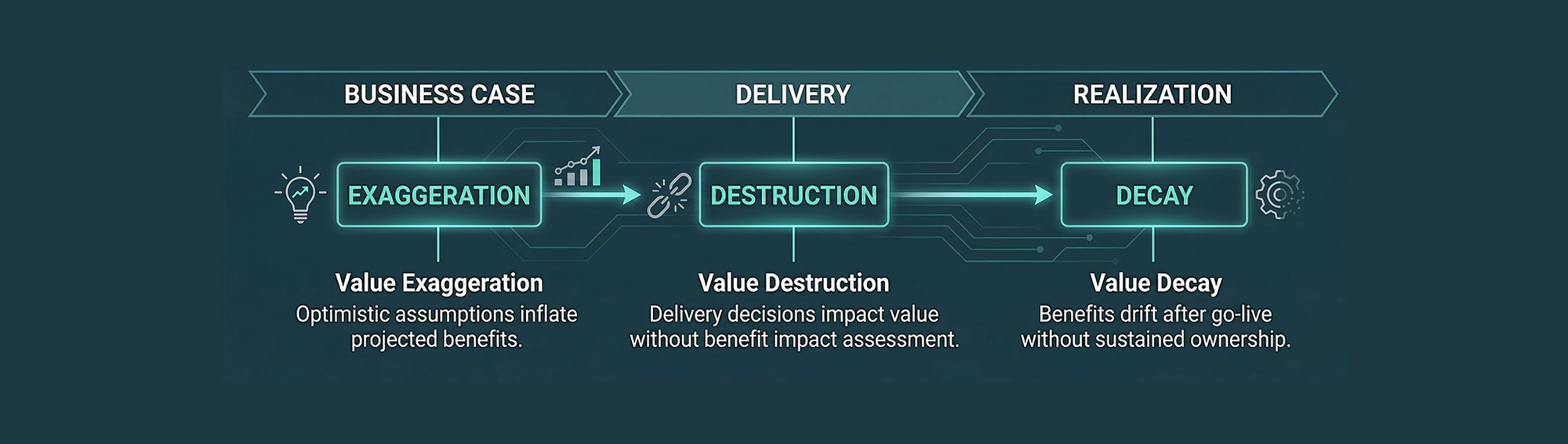
  • The three predictable stages of value erosion: exaggeration, destruction, and decay
  • Why spreadsheets and disconnected PPM tools struggle to protect value
  • What organizations need in place to manage benefits effectively across the transformation lifecycle
  • How Amplify embeds value governance directly into the execution layer

Building the Foundation for Value

Transformation initiatives typically start with the best of intentions.

Organizations develop well-modeled business cases, define clear strategic objectives, and assemble experienced delivery teams. Financial projections demonstrate strong returns and justify the investment in capital and resources.

At this stage, everything points toward success.

However, the way benefits are modeled during business case development can introduce risk early in the lifecycle. Enthusiasm for change and the pressure to secure funding can lead to optimistic assumptions about the value a program will generate. Strategic ambitions are translated into financial projections that reflect economic potential, but may not yet reflect the operational reality required to deliver that value.

Once execution begins, delivery pressures start to emerge. Timelines move. Costs shift. Scope evolves as teams respond to constraints and new information.

Then, toward the end of the program, when teams are fatigued and deadlines loom, the focus often shifts to simply completing delivery rather than protecting the final value outcome.

Across this lifecycle, value erosion can occur gradually.

In practice, it typically follows three stages: exaggeration, destruction, and decay.

Preventing these stages requires more than financial reporting. It requires a system that actively governs value from planning through realization.

Stage One: Preventing Value Exaggeration

Value exaggeration occurs during business case development when projected benefits become inflated by optimistic assumptions.

Common indicators include:

  • Benefits reverse-engineered to justify estimated program cost
  • Strategic objectives translated into financial projections without operational baselines
  • Double-counted or overlapping benefits across initiatives
  • Key assumptions not explicitly documented or linked to measurable value drivers

Once capital is approved, these assumptions are often captured in spreadsheets or slide decks that sit outside the systems used to manage delivery.

As a result, they are rarely revisited or validated as execution progresses.

What mature organizations do differently

  • Link benefits to clearly defined organizational value drivers
  • Establish agreed baselines before capital approval
  • Capture benefit assumptions explicitly and make them visible
  • Connect projected benefits directly to initiatives within the execution environment

Outcome-Driven Discipline begins at capital approval — not at delivery.

Stage Two: Preventing Value Destruction During Delivery

Once delivery begins, governance attention often shifts toward maintaining schedule and budget performance.

Scope changes are evaluated based on cost impact. Timeline adjustments are assessed in nominal terms. Steering committees focus on milestone completion.

What is often missing is a structured assessment of the impact these decisions have on value realization.

Common indicators of value destruction include:

  • Scope reductions approved without recalculating benefit impact
  • Delivery delays accepted without modeling time-to-benefit consequences
  • Decisions made without visibility into the broader economic implications across the portfolio

Without integrated financial and delivery data, organizations cannot evaluate the economic consequences of execution decisions in real time.

What mature organizations do differently

  • Embed benefit impact assessment within change governance
  • Maintain real-time visibility into benefit forecasts
  • Link delivery performance directly to value trajectory
  • Provide executives with portfolio-level visibility into economic outcomes

Data-Informed Decision Making must operate within delivery workflows — not after them.

“Without integrated financial and delivery data, organizations cannot evaluate the economic consequences of execution decisions in real time.”

Stage Three: Preventing Value Decay After Go-Live

Even when a program is delivered on time and on budget, value is not automatically realized.

Following go-live, delivery teams transition out. Finance may continue tracking forecasts and variances, often in isolation. Operational leaders inherit benefit accountability without structured governance support.

This is where value decay can begin.

Common indicators include:

  • Adoption rates falling below forecast with no recalibration of expected benefits
  • Original business case assumptions never revisited
  • Benefits tracked outside enterprise execution systems
  • No structured escalation or intervention when performance deviates

Benefits realization often becomes a passive monitoring exercise rather than an active management discipline.

What mature organizations do differently

  • Transition benefit ownership formally into operational governance
  • Maintain dynamic benefit forecasts beyond go-live
  • Integrate benefit variance reviews into enterprise performance forums
  • Enable early intervention when value signals deviate

Benefits realization continues well beyond program delivery.

Why Spreadsheets and Disconnected Systems Struggle to Protect Value

Many organizations attempt to manage benefits using spreadsheets layered alongside project management tools and financial systems.

This creates structural fragmentation:

  • Delivery performance lives in one system
  • Financial forecasts live in another
  • Governance decisions rely on manually consolidated reporting

The consequences are predictable:

  • Assumptions cannot be dynamically updated
  • Scope changes cannot be economically modeled
  • Executive visibility requires significant manual effort
  • Early signals of value erosion are often missed

Spreadsheets may work for small initiatives, but they do not scale to enterprise transformation portfolios.

Benefits discipline requires integrated systems that connect strategy, delivery, and financial outcomes.

Embedding Benefits Governance into the Execution Layer

Amplify connects strategy, initiatives, governance, and financial outcomes within a single execution environment.

This enables organizations to:

  • Link every initiative to measurable financial and non-financial value drivers
  • Maintain visible baselines and dynamic benefit forecasts
  • Model the impact of scope, timing, and investment changes before decisions are made
  • Detect early signals of value erosion
  • Provide executives with real-time portfolio-level value visibility

Benefits realization moves from retrospective reporting to proactive intervention.

Delivery decisions are evaluated not only on cost and schedule — but on economic consequence.

From Reporting Value to Engineering Value

Preventing exaggeration, destruction, and decay requires disciplined governance and connected systems.

Outcome-Driven Discipline ensures value assumptions are explicit and governed.
Data-Informed Decision Making ensures execution decisions are economically grounded.

When benefits are embedded within the execution layer, organizations move from directional ambition to engineered value realization.

Value does not disappear.

It erodes when it is not actively managed.

Stop managing benefits in spreadsheets.

See how Amplify embeds benefits governance directly into your execution layer — enabling early intervention and economically grounded transformation decisions.

→ Request a Demo

What Is Strategic Portfolio Management (SPM)?

What this article explains

  • What Strategic Portfolio Management (SPM) really means
  • Why SPM has become an executive discipline — not just a PMO capability
  • How SPM evolved from traditional portfolio governance
  • Who uses SPM inside mature enterprises
  • Why SPM requires execution architecture — not just reporting tools

Who this is for

Chief Transformation Officers, EPMO leaders, strategy executives, finance leaders, and enterprise decision-makers responsible for turning strategic intent into measurable value.

Strategic Portfolio Management Defined

Strategic Portfolio Management (SPM) is the executive discipline of aligning investments, initiatives, and resources to realize enterprise strategy — and continuously optimizing those decisions to maximize value.

It connects:

  • Strategic objectives
  • Capital allocation
  • Programs and initiatives
  • Capacity and capability
  • Measurable financial and operational outcomes

SPM shifts the conversation from operational delivery to strategic value.

It replaces the question:

“Are we delivering projects on time?”

With the more important question:

“Are we investing in the work that will create the greatest enterprise value — and how do we know?”

Leading advisory thinking reinforces this shift.

McKinsey & Company has long emphasized active portfolio management — reallocating capital and management attention dynamically to maximize long-term value creation.

Bain & Company similarly highlights that sustainable performance depends on disciplined portfolio choices aligned to competitive advantage and economic return.

SPM operationalizes this philosophy inside the enterprise.

It is not an upgrade to reporting.
It is a structural capability for value stewardship.

Why SPM Has Become Essential

Enterprise strategy has become more complex — and less forgiving.

Organizations today are simultaneously managing:

  • Digital and technology transformation
  • Cost optimization programs
  • Capability uplift and operating model redesign
  • Innovation portfolios
  • M&A integration
  • Regulatory and compliance initiatives

All under constrained capital, limited specialist talent, and rising shareholder expectations.

In this environment, static annual planning cycles are insufficient.

SPM enables organizations to:

  • Explicitly evaluate trade-offs
  • Prioritize based on strategic contribution
  • Model investment scenarios
  • Forecast financial and operational impact
  • Rebalance portfolios dynamically

It transforms strategy from a planning artifact into an active operating discipline.

“Enterprise strategy has become more complex — and less forgiving.”

Who Uses Strategic Portfolio Management?

SPM is not owned by a single function. It operates at the intersection of strategy, finance, and transformation.

In mature organizations, SPM is used by:

Executive Leadership Teams

CEOs and CFOs rely on portfolio visibility to assess whether capital allocation decisions are translating into measurable strategic progress — and to rebalance investmentswhen conditions shift.

Chief Transformation Officers & Transformation Offices

Responsible for enterprise change, they use SPM to coordinate programs, embed governance discipline, and track value realization across multiple initiatives.

Enterprise PMOs (EPMOs)

EPMOs use SPM to move beyond status reporting into strategic prioritization and optimization.

Strategy & Corporate Development Teams

These teams align growth initiatives, integration programs, and cost initiatives with long-termvalue creation objectives.

Finance Leaders

Finance increasingly plays an active role in portfolio governance, modeling ROI, forecasting benefit realization, and informing trade-off decisions.

SPM delivers its greatest impact when it becomes an executive decision capability — not simply areporting mechanism within a PMO.

The Evolution: From PMO to EPMO to SPM

Strategic Portfolio Management did not appear in isolation. It reflects a broader evolution inenterprise governance.

Traditional PMO: Backward-Looking Control

Traditional Project or Program Management Offices focused on:

  • Status reporting
  • Schedule adherence
  • Budget tracking
  • Governance hygiene

Their mandate was largely retrospective:

Did we deliver what we said we would?

Necessary — but limited.

“SPM is not owned by a single function. It operates at the intersection of strategy, finance, and transformation.”

EPMO/ Transformation Office: Forward-Looking Alignment

As organizations increased the scale and complexity of change, the Enterprise PMO (EPMO) or Transformation Office emerged.

These teams shifted focus toward:

  • Strategic alignment
  • Cross-functional coordination
  • Program-level outcome management
  • Forward-looking planning

The core question became:

Are our programs aligned to strategy?

This represented a significant maturity step.

Strategic Portfolio Management: Continuous Value Optimization

SPM extends that evolution further.

It reframes governance around value optimization:

  • Are we funding the highest-value initiatives?
  • What is the marginal return of each investment?
  • How will delays impact forecast benefits?
  • Should capital or capacity be reallocated?
  • What does our portfolio tell us about future performance?

If traditional PMOs tracked activity, and EPMOs aligned programs to strategy, SPM enables leaders to actively optimize enterprise value on an ongoing basis.

It transforms portfolio governance into strategic stewardship.

The Structural Gap: Visibility Without Value

Many portfolio tools operate bottom-up.

They start with a list of projects, roll them into programs, and aggregate upward into portfolio views.

This approach answers:

“What are we doing?”

But it rarely starts with:

“What are we trying to achieve?”

Organizations often begin with a project list and plan upward. Strategy becomes a retrospective mapping exercise.

A mature SPM approach begins top-down:

  • Define strategic outcomes
  • Identify the initiatives required to deliver them
  • Allocate capital and capacity accordingly
  • Continuously measure value realization

Many organizations adopt portfolio tools but still struggle to realize value because:

  • Financial modelling is disconnected from execution data
  • Governance is procedural rather than analytical
  • Reporting emphasizes milestones, not impact
  • Data is fragmented across systems

The result is visibility into activity — but limited clarity on value creation.

SPM as a discipline requires execution architecture that embeds strategic logic directly into operational workflows.

Amplify: Enabling SPM and Strategy Execution

SPM defines the discipline of strategic portfolio decision-making.

Strategy ExecutionManagement (SEM) ensures that strategy is delivered in practice.

Amplify operates across both.

Amplify connects:

  • Strategy
  • Initiatives and programs
  • Financial modelling and benefit tracking
  • Capacity and resource management
  • Governance workflows
  • Executive insight and optimization

Within a unified execution architecture.

Rather than functioning as a static reporting layer, Amplify enables:

  • Rapid stand-up of strategic programs
  • Direct linkage between objectives and funded initiatives
  • Real-time financial forecasting
  • Scenario modeling for prioritization decisions
  • Embedded governance with finance involvement
  • Decision-grade executive visibility

Where SPM articulates what mature portfolio discipline looks like, Amplify provides the independent platform to execute it.

It enables strategy leaders, Transformation Offices, and executive teams to operate not as observers of performance — but as active stewards of enterprise value.

This intersection between SPM and strategy execution is where the next evolution of enterprise governance is emerging — a topic we explore in our next article.

The Bottom Line

Strategic Portfolio Management is not a trend or a tool category.

It is the structural capability that determines whether strategy produces measurable value.

Its evolution — from PMO control, to EPMO alignment, to SPM optimization — reflects a broader enterprise shift:

From tracking activity
To aligning outcomes
To continuously optimizing value.

Organizations that treat SPM as executive decision infrastructure gain a structural advantage.

Those that treat it as enhanced reporting do not.

The differentiator is execution architecture.

And that is where Amplify operates.

See How Strategic Portfolio Decisions Translate Into Measurable Value

Discover how Amplify connects strategy, investment, and financial outcomes in one execution architecture.

Why Leaders Struggle to Intervene Early

Turning insight into action in modern transformations

Most transformation leaders can sense when something isn’t working.

Initiatives continue, but outcomes stall.
Momentum builds, but impact flattens.
Activity increases, but confidence quietly erodes.

The problem isn’t ignorance, there’s just nothing to confirm assumptions.

The problem is intervention — knowing when and how to step in early enough to change the outcome.

Why Intervention Is Harder Than It Sounds

In theory, pausing work to reassess should be straightforward.

In practice, it rarely is.

That’s because most transformation environments lack the conditions that make early intervention possible:

  • Execution systems reward continuity
    Funding models, governance cycles, and reporting rhythms make it easier to continue than to intervene.
  • Signals arrive too late
    Lagging indicators confirm problems only after momentum and political capital are already sunk.
  • Outcomes are diffuse or abstract
    When ownership is unclear, stopping or changing direction feels subjective and risky.

The result is familiar:
leaders sense drift, but hesitate to act.

Visibility Isn’t the Same as Actionable Insights

Many organizations respond to this challenge by investing in visibility.

More dashboards.
More KPIs.
More reporting.

But visibility alone does not create decisiveness.

Seeing activity — or even performance — doesn’t automatically answer the questions leaders need toact on:

  • Is this initiative still likely to deliver its intended outcome?
  • Is value materializing early enough to justify continued investment?
  • Should we continue as-is, adjust, pause, or redirect — now?

Without decision-grade insight, momentum becomes the default decision-maker.

“The problem is intervention — knowing when and how to step in early enough to change the outcome.”

The Real Capability Leaders Are Missing

High-performing transformations don’t rely on heroic leadership moments.

They design execution so that intervention is expected, structured, and supported.

That capability rests on three foundations:

  1. Outcomes as the primary reference point
    Initiatives exist to serve outcomes — not the other way around.
  2. Leading indicators of value
    Signals that show trajectory, not just historical performance.
  3. Explicit decision moments
    Natural points in the execution rhythm where leaders are expected to decide:
    continue, adjust, pause, redirect — or stop.

This shifts intervention from being disruptive to being normal.

How This Works in Practice with Amplify

Amplify is designed to close the gap between insight and intervention.

Not by adding more reporting — but by structuring execution around outcomes and decisions.

In practice, this means:

  • Outcomes are explicit and continuously revisited
    Progress is judged by impact, not activity.
  • Value is tracked as a trajectory, not a promise
    Leaders can see early whether work is trending toward outcomes — or away from them.
  • Decision points are built into execution
    Making pause, reassessment, and redirection part of the operating rhythm.
  • Intervention becomes defensible
    Decisions are grounded in shared outcomes and evidence, not opinion or politics.

The result is the ability to identify the right actions that deliver the outcomes.

It’s execution that stays aligned to value.

From Insight to Action

The ability to intervene early is not a leadership personality trait.

It’s a designed capability.

When execution is structured around outcomes, evidence, and decision moments:

  • leaders act sooner,
  • teams stay focused,
  • and transformations stop drifting and start delivering.

The cost of transformation failure isn’t usually stopping too soon.

It’s continuing too long.

Learn how Amplify is helping leaders intervene earlier — before momentum becomes sunk cost.

Leadership & Accountability at Scale: Designing Ownership into Enterprise Execution

What this article covers

  • Why leadership accountability breaks in large transformation portfolios
  • The operational difference between symbolic sponsorship and structural ownership
  • How to design accountability into strategy execution systems
  • The role of visibility, governance, and value linkage in sustaining ownership

Accountability Is Not a Cultural Trait — It’s a System Design Choice

Most organizations believe accountability is cultural.

It’s discussed in leadership forums.
It appears in performance principles.
It’s reinforced in town halls.

Yet when transformation portfolios expand, accountability frequently weakens — not because leaders lack intent, but because execution systems do not structurally reinforce ownership.

In enterprise environments, accountability must be engineered.

Without system-level design, ownership becomes dependent on personality, energy, or individual discipline — none of which scale reliably.

Where Accountability Typically Breaks

Across large transformation portfolios, three failure patterns are common.

1. Ownership Is Assigned at the Initiative Level — Not the Outcome Level

Many organizations clearly assign initiative leads.

Fewer explicitly assign owners to:

  • Revenue targets
  • Cost savings outcomes
  • Margin improvements
  • Adoption thresholds

Without outcome-level ownership, delivery becomes disconnected from realized impact.

2. Visibility Is Fragmented

Leaders often see:

  • Project status in one system
  • Financial tracking in another
  • Risk registers in spreadsheets
  • Benefits tracking in static documents

When visibility is fragmented, accountability diffuses.

Executives cannot easily see:

  • Which outcomes are trending below target
  • Which initiatives are driving (or failing to drive) value
  • Who is accountable for closing performance gaps

Fragmented insight weakens ownership.

3. Governance Reviews Activity — Not Impact

Steering committees frequently focus on:

  • Timeline adherence
  • Budget consumption
  • Risk updates

But fewer governance forums consistently review:

  • Forecast value realization
  • Variance to target outcomes
  • Decision trade-offs required to protect value

When governance centers on activity, accountability follows activity.

When governance centers on outcomes, accountability strengthens.

“Accountability frequently weakens — not because leaders lack intent, but because execution systems do not structurally reinforce ownership.”

Designing Accountability into the Execution Architecture

In execution-mature organizations, leadership accountability is reinforced across multiple layersof the operating model.

Within the Execution Architecture, this spans:

1. Work Containers

Clear initiative structures aligned to strategic outcomes — not isolated projects disconnected from value.

2. Value & Performance

Explicit linkage between initiatives and measurable financial or operational targets. Forecastand realized impact are visible and attributable.

3. Governance & Control

Stage gates and steering reviews that trigger decisions, not just updates. Performance deviations prompt action.

4. Insight & Optimization

Executive dashboards that surface outcome ownership clearly — making accountability visible across portfolios.

Accountability strengthens when ownership is reinforced consistently across these layers.

What Structural Accountability Looks Like in Practice

In mature Transformation Offices:

  • Each strategic objective has a named accountable executive.
  • Initiatives are mapped directly to measurable value drivers.
  • Forecast impact updates dynamically as delivery shifts.
  • Governance forums review outcome variance alongside delivery progress.
  • Underperformance triggers reprioritization or intervention.

Accountability becomes part of the operating rhythm — not a reactive conversation.

This design reduces decision latency and protects enterprise value.

The Role of Technology in Sustaining Ownership

While accountability is a leadership discipline, it is sustained by visibility.

Enterprise strategy execution platforms play a critical role by:

  • Linking strategy to initiatives to value outcomes
  • Making accountable owners explicit and visible
  • Surfacing real-time forecast impact
  • Enabling cross-portfolio prioritization
  • Supporting governance workflows tied to decision points

When ownership, performance, and decision-making are connected within a single system, accountability becomes durable.

It no longer relies on memory, meetings, or manual reporting.

It becomes structural.

Why This Matters Before Benefits Realization

Leadership & Accountability is a prerequisite to realized value.

If no one is structurally accountable for outcomes:

  • Value forecasts drift
  • Savings assumptions go unchallenged
  • Revenue targets degrade
  • Strategic confidence erodes

Before organizations can fully institutionalize benefits realization discipline, they must ensure ownership is clear, visible, and persistent.

Accountability is the bridge between intent and measurable impact.

Without it, value creation remains theoretical.

With it, value realization becomes executable.

Moving from Accountability Theatre to Execution Discipline

Transformation maturity is not achieved through more reporting.

It is achieved through:

  • Concentrated ownership
  • Outcome-linked governance
  • Integrated visibility
  • Decisive portfolio prioritization

When leadership accountability is designed into the execution system, transformation stops being performative and starts becoming predictable.

And predictability is what enterprise leaders ultimately require.

How Amplify Reinforces Structural Accountability

Amplify is designed to embed accountability directly into enterprise execution.

Within Amplify, strategic objectives are explicitly linked to initiatives, measurable value drivers, and named accountable owners. Executive dashboards surface outcome ownership clearly across portfolios — not just delivery status, but forecast and realized impact. Governance workflows are configurable and tied to decision points, ensuring that deviations trigger action rather than passive reporting.

Because strategy, execution, value, and governance operate within a single system, ownership remains visible and persistent. Accountability is not dependent on memory, meetings, or disconnected spreadsheets — it is structurally reinforced.

This is how organizations move from accountability theatre to execution discipline at scale.

Explore How Amplify Embeds Accountability at Scale

See how Amplify connects strategy, initiatives, value, governance, and executive insight withina single configurable platform.

👉 Request a Strategic Walkthrough

Explore how Amplify enables decision-centric governance

From Governance to Decisions: Operationalizing Transformation at Scale

For most large enterprises, it is no longer a discrete program with a start and end date. It is continuous, cross-functional, and deeply tied to how the organization allocates capital, capacity, and leadership attention.

Yet while enterprise transformation itself has evolved, governance has largely stayed the same.

The result?

Plenty of oversight — and still too many slow, misaligned, or reactive decisions.

As transformation becomes business as usual, the ability to make consistent, evidence-based decisions becomes the true differentiator between activity and outcomes.

This blog explores what it actually takes to move from governance as oversight to governance as a decision system — and how organizations can operationalize that shift in practice.

Why Traditional Governance Still Struggles to EnableDecisions

Most enterprises don’t lack governance structures. They have steering committees, stage gates, investment boards, and reporting cycles.

What they lack is decision effectiveness.

Common symptoms include:

  • Decisions delayed because the “full picture” isn’t available
  • Escalations driven by urgency or politics rather than evidence
  • Forums focused on status updates instead of trade-offs
  • Accountability that blurs once decisions move into execution

In these environments, governance becomes a coordination overhead rather than a leadership advantage.

The issue isn’t that leaders aren’t engaged — it’s that the system surrounding them doesn’t make decisions easier.

The Hidden Trap: Static Business Cases and Irreversible Decisions

One of the most common failure points in traditional governance is the static business case.

An investment decision is made based on a set of assumptions — often months old, sometimes external — and once approved, the initiative is effectively locked in. From that point on, governance focuses on delivery against plan rather than continued validation of value.

Few organizations are willing to stop a major initiative once it is underway, even when:

  • Market conditions change
  • Assumptions no longer hold true
  • Benefits are eroding
  • Better alternatives emerge

Reviews tend to happen after the fact — when it is already too late to change course.

This is how portfolios become overcommitted, slow to adapt, and increasingly disconnected from real business outcomes.

Reframing Governance as a Decision System

A decision-centric view of governance starts with a simple shift in intent:

Governance exists to enable high-quality decisions — not to produce reports, approvals, or rituals.

When viewed through this lens, effective governance consistently provides four things:

1. Clarity

Who is accountable for which decisions, at what level, and on what cadence.

2. Context

How each decision connects to strategy, dependencies, risk, capacity, and value.

3. Confidence

Evidence-based inputs that allow leaders to weigh trade-offs, not just react to issues.

4. Continuity

A record of decisions made, assumptions taken, and outcomes achieved — enabling learning over time.

Without these elements, governance quickly reverts to discussion rather than decision-making.

What Decision-Centric Governance Requires in Practice

Designing governance as a decision system isn’t about adding more controls. It’s about ensuring the right information, ownership, and signals are available before leaders enter the room.

In practice, this requires:

  • A connected view of strategy, initiatives, and outcomes
  • Clear decision rights and escalation paths
  • Visibility into progress, risk, dependencies, and benefits in near real time
  • The ability to assess trade-offs across initiatives — not in isolation

Crucially, it also requires moving from static, point-in-time business cases to living business cases that can be monitored, challenged, and adjusted as conditions change.

This is what enables governance to support real decisions —not just reaffirm past ones.

“Governance exists to enable high-quality decisions — not to produce reports, approvals, or rituals.”

Agile Portfolio Management: Where Governance Meets Reality

When governance is treated as a decision system, portfolio management becomes inherently more agile.

Rather than approving investments once and hoping for the best, leaders can:

  • Review portfolios on a regular cadence (often quarterly)
  • Re-test assumptions as new information emerges
  • Compare initiatives based on current value, risk, and capacity
  • Make explicit decisions to stop, start, expand, or reallocate

This is not about constant churn.

It is about maintaining strategic control in an environment where change is constant.

Agile portfolio management is the practical expression of decision-centric governance at scale.

The Evolving Role of the Transformation Office

This shift has significant implications for TransformationOffices, Enterprise PMOs, and Strategy Execution teams.

In high-performing organizations, these functions no longer focus on producing reports or enforcing process compliance. Instead, they operate as decision enablement engines.

Their role increasingly includes:

  •  Designing governance models aligned to decision velocity and maturity
  • Ensuring leaders see value, risk, and capacity together
  • Triggering interventions based on signals, not surprises
  • Maintaining continuity between strategic intent and execution reality

In short, they help leaders decide with confidence — at scale.

Why Platforms Matter More Than Ever

Decision-centric governance cannot be sustained through manual coordination alone.

As transformation portfolios grow in size and complexity, organizations need decision infrastructure — not just execution tracking.

The right platform:

  • Connects strategy, execution, and value in a single system
  • Makes decision context visible before governance forums
  • Supports configurable governance models across different maturities
  • Enables real-time business case monitoring and portfolio trade-offs

This isn’t about automating governance.

It’s about making governance effective.

Making the Shift That Matters

Transformation succeeds or fails at the point of decision.

Organizations that design governance around faster, better, and more confident decisions, and enable that design with the right operating model and platform — consistently outperform those that rely on oversight alone.

When governance functions as a decision system, it becomes a strategic advantage rather than an administrative burden.

For a deeper perspective on how this shift aligns with the evolution of Transformation 4.0, read our founder’s latest post on governance as a decision system.

Explore how Amplify enables decision-centric governance

What Comes After Microsoft Project Online?

From Project Tracking to Enterprise Strategy Execution

With Microsoft Project Online becoming obsolete in September, many organizations are asking the same question:

What should replace it?

For some, this feels like a straightforward tooling decision — migrate projects, retrain users, move on. But for many organizations, the end of Project Online exposes something deeper.

Because Project Online didn’t just manage projects. It quietly became the system many organizations relied on to understand what was happening across their change portfolio.

And that capability still matters — even if the tool itself is going away.

Why Project Online Became So Embedded

Project Online succeeded because it offered something rare at the time:

  • Centralized portfolio visibility
  • A shared view across initiatives and programs
  • Governance checkpoints and approvals
  • Executive-level reporting beyond individual projects

But fundamentally, it was designed for a different era.

Project Online was built to answer: “Are our projects on track?”

Today’s leaders are asking a very different question: “Are our investments delivering the outcomes and value we promised?”

The Risk of a Like-for-Like Replacement

Microsoft’s guidance often points customers toward lighter-weight execution tools. These can be effective for task management, but they don’t replace what Project Online was actually used for.

A like-for-like replacement often results in:

  • Fragmented portfolio visibility
  • Weaker governance and escalation
  • Reporting that looks busy but lacks insight
  • A return to spreadsheets for executive decisions

In other words, organizations risk losing strategic oversight, not just changing tools.

A Better Question: What If This Is an Upgrade Moment?

Rather than asking “What replaces Project Online?”, leading organizations are asking: “What capability do we actually need now?”

This is where the conversation shifts — from project management to enterprise strategy execution.

How Amplify Fits — And Why It’s Different

Amplify is not a task-level project tool. It is designed for organizations that have moved beyond managing projects, and need confidence that strategy is turning into results.

Where Project Online focused on activity, Amplify focuses on outcomes.

At a glance:

Project OnlineAmplify
Project- and schedule-centricStrategy- and outcome-centric
Task and milestone trackingValue, benefits, and ROI visibility
PMO-ledBusiness-led (CTO, Transformation Office, Finance)
Static reportingLive executive dashboards
Heavy configurationFast time to value
One-size governanceAdaptive, enterprise governance

Amplify does not replace delivery tools. It sits above them, providing the portfolio intelligence layer executives rely on.

“But What About Migration?”

Migration is often the biggest concern when organizations plan for life after solutions they’ve been using for a while, and it’s where many transitions become more complex thanthey need to be.

Amplify is designed to make transitions practical, low-effort, and decision-led, rather than a heavy task-by-task rebuild.

With Amplify, organizations can selectively migrate what matters most, while confidently retiring what no longer adds value.

How Amplify simplifies migration

  • Structured portfolio migration, not task overload
    Amplify provides guidance to help teams identify which information should be brought across — such as strategic objectives, active initiatives, outcomes, dependencies, benefits, and key risks, and what can safely be     archived, including completed task-level activity.
  • Continuity for active work, without rework
    For initiatives that are still in flight, Amplify supports rapid setup using existing project structures, milestones, and lessons learned — accelerating time to value without recreating detailed plans from scratch.
  • Outcome-led historical context
    Rather than carrying forward every activity, Amplify helps organizations preserve what is most valuable from historical programs: outcomes delivered, benefits realized (or missed), governance decisions, and insights that inform better future execution.
  • Minimal disruption to delivery teams
    Delivery teams continue working in their existing execution tools. Amplify sits above those tools, providing enterprise-wide visibility without forcing change at the team level.

And at the same time, organizations gain:

  • Elevated decision-making and governance across the portfolio
  • Clear accountability for outcomes and value realization
  • A single, trusted view of enterprise change aligned to strategy

As many customers put it:

“We didn’t need another project tool. We needed clarity.”

Who This Matters Most To

The end of Project Online is particularly significant for:

  • Chief Transformation Officers
  • Transformation Offices and EPMOs
  • CFOs accountable for benefits realization
  • CEOs seeking confidence in execution

These leaders aren’t looking for a new Gantt chart. They are looking for visibility, accountability, and value.

A Natural Evolution — Not a Forced Switch

Project Online helped organizations manage complexity at a point in time.
Amplify helps them navigate it now.

As organizations face:

  • Continuous transformation
  • Capital and cost pressure
  • M&A integration
  • Heightened executive scrutiny

The need has shifted from tracking activity to executing strategy with discipline.

Final Thought

Project Online may be going away — but the need for enterprise-wide clarity, governance, and value delivery is not.

For organizations ready to move beyond project tracking and into confident strategy execution, this is not just a replacement decision. It is an upgrade.

Want to explore what comes next?

If you’re planning for life after Project Online and want to understand how Amplify supports enterprise strategy execution and value creation, we’d be happy to talk.

Request a personalized demo

From Insight to Intervention

A Practical Guide to Decision-Grade Execution

Why visibility alone doesn’t change outcomes — and what execution-mature organizations do differently.

Why Visibility Rarely Translates Into Better Outcomes

Most organizations today are not constrained by a lack of information.
Across enterprises, data has become more accessible, dashboards more sophisticated, and reporting more frequent. Transformation Offices and EPMOs typically have portfolio views, initiative metrics, benefit forecasts, and risk registers readily available.

Despite this, execution outcomes often remain inconsistent.

Decisions are delayed or deferred. Trade-offs are avoided. Risks are acknowledged but not acted upon early enough to change results. Value leakage becomes visible only once outcomes are already locked in.

This disconnect reflects a fundamental misunderstanding: visibility alone does not change execution outcomes. What matters is whether insight is decision-grade.

What “Decision-Grade” Execution Actually Means

Decision-grade execution is not about generating more data or producing better reports. It is about ensuring that insight is structured and timed to influence decisions while meaningful options still exist.

In practice, decision-grade insight has several defining characteristics. It surfaces early enough to enable intervention, is explicitly connected to decisions that need to be made, highlights trade-offs and exposure rather than just performance, and reaches the level of authority that can act.

In less mature execution environments, data tends to explain what has already happened. In more mature environments, insight actively shapes what happens next.

The Visibility–Decision Gap

A common pattern across stalled transformations is not a lack of information, but a failure to translate insight into action.

Organizations often find themselves in situations where data exists but behavior does not change. Risks are logged and discussed, yet momentum continues. Benefits are forecast confidently, but not actively protected as conditions shift. Issues escalate only once choices are limited and outcomes difficult to reverse.

This creates a false sense of control. Leaders can see activity clearly, but lack the ability to intervene decisively.

The gap emerges when insight is optimized primarily for reporting completeness, executive reassurance, or post-hocexplanation, rather than for timely decision-making.

Lagging Insight vs. Leading Insight

One of the clearest indicators of execution maturity is the balance between lagging and leading insight.

Lagging insight helps organizations understand whether commitments were met: milestones achieved, spend tracked to plan, and benefits realized after delivery. This information is necessary, but insufficient.

Leading insight, by contrast, focuses on exposure and optionality. It surfaces when assumptions begin to break, where dependencies are becoming fragile, which initiatives are crowding out value, and where intervention would still change the outcome.

Most organizations believe they are data-driven, yet rely heavily on lagging indicators. Decision-grade execution depends on deliberately shifting toward leading insight that supports earlier, more confident intervention.

Why Governance Alone Doesn’t Close the Gap

When late insight becomes visible, the instinctive organizational response is often structural. Additional forums are introduced, reporting frequency increases, escalation paths are tightened, and governance cadence intensifies.

While these changes can improve oversight, they rarely improve outcomes on their own.

Governance mechanisms do not create decision-grade insight. Without insight that is timely, connected, and relevant to specific choices, governance becomes a review function rather than an intervention mechanism.

More mature execution environments design governance explicitly around decisions. This includes defining decision thresholds, clarifying trade-off moments, enabling reprioritization and reallocation, and establishing clear intervention rights before outcomes are locked in.

Execution as a Decision System

At higher levels of maturity, execution is treated not as a collection of dashboards or forums, but as a connected decision system.

In these environments, strategy, portfolios, initiatives, and value are visible together rather than in isolation. Signals flow naturally to the level where action can be taken, and decisions are revisited as conditions evolve rather than defended through momentum.

This systemic view enables earlier intervention, more deliberate trade-offs, and fewer surprises — not because leaders are working harder, but because decisions are supported at the right time and with the right context.

A Practical Self-Check for Leaders

A simple way to assess whether execution insight is truly decision-grade is to reflect on a few practical questions:

  • When insight changes, do decisions reliably follow?
  • Are risks surfaced early enough to meaningfully change direction
  • Can leaders see which initiatives are competing for capacity or diluting value?
  • Is stopping or redirecting work treated as disciplined execution, rather than failure?

The answers to these questions often reveal more about execution maturity than any dashboard.

Why This Matters in Transformation 4.0

In Transformation 4.0, the cost of late decisions is materially higher than it was in earlier eras. Portfolios are broader, capital is more constrained, dependencies are deeper, and the distance between decision and impact is shorter.

Execution maturity is no longer about control through reporting.
It is about confidence through timely, informed intervention.

Decision-grade execution is what makes that possible.

Explore your execution maturity.
If this guide resonates, the next step is understanding how decision-grade execution shows up across your organization — and where earlier intervention could still change outcomes.

Learn more about Transformation 4.0 and the execution maturity journey, or start a conversation about what this shift could mean for your Transformation Office or EPMO.

Programs, Portfolios, and Performance: Execution Design in Transformation 4.0

Designing execution structures that scale governance, insight, and performance across transformation portfolios.

What We’re Seeing in Transformation Offices

As organizations move into Transformation 4.0, execution has become continuous, portfolio-led, and value-driven.

What has not kept pace is how execution is structured.

Across Transformation Offices and EPMOs, we see the same pattern emerging:

  • Multiple portfolios running in parallel
  • Different governance approaches by initiative
  • Inconsistent terminology, workflows, and reporting
  • Leaders struggling to see performance clearly — until it is too late to intervene

The challenge is no longer delivery capacity. It is execution coherence at scale.

Why Execution Design Has Become a Leadership Issue

In earlier transformation eras, execution was optimized for discrete programs:

  • Clear start and end points
  • Centralized oversight
  • Milestone-driven success

That approach worked when transformation was episodic. In Transformation 4.0, the execution environment has changed:

  • Portfolios replace standalone programs
  • Value expectations are continuous
  • Trade-offs matter more than completion
  • Speed of insight matters more than reporting rigor

Execution design now directly affects performance, not just delivery.

The Hidden Cost of Fragmented Execution

As transformation portfolios scale, execution complexity compounds.

We consistently see organizations where:

  • Governance varies across initiatives
  • Reporting structures are not comparable
  • Decision cycles lengthen due to fragmented insight
  • Flexibility increases configuration and administrative overhead
  • Intervention happens after value leakage has already occurred

This is not a tooling problem. It is an execution design problem.

From Managing Programs to Governing Performance

Transformation 4.0 shifts the role of the Transformation Office.

The focus moves from coordinating individual initiatives to governing portfolios as performance systems.

That shift requires execution structures that:

  • Preserve a common language across initiatives
  • Standardize governance where consistency matters
  • Allow flexibility only where it adds value
  • Enable comparable insight across portfolios
  • Support faster trade-offs across capital, capacity, and priorities

The question leaders now face is not how flexible their execution model is —
but whether it helps them see, decide, and intervene in time.

Execution Maturity as a Design Choice

Execution maturity is often misunderstood as a progression toward greater complexity.

In practice, maturity shows up in how deliberately execution is designed:

  • Whether strategy, portfolios, and initiatives remain clearly connected
  • Whether governance supports timely decisions rather than slowing them down
  • Whether insight arrives early enough to influence outcomes
  • Whether accountability holds as scale increases

This is why maturity in Transformation 4.0 is less about adding structure — and more about ensuring execution continues to work under real operating pressure.

These execution challenges are why many Transformation Offices are stepping back to assess how well execution holds together at scale — to understand where complexity is enabling performance, and where it is holding execution back.

Why This Matters for CTOs and Transformation Leaders

When execution is designed deliberately, organizations gain:

  • Clear portfolio-level visibility
  • Faster intervention and decision-making
  • Reduced governance overhead
  • Stronger ownership and accountability
  • Execution that can be sustained as business as usual

In Transformation 4.0, execution structures are no longer background infrastructure.

They are a strategic lever for performance.

How Amplify Supports Execution in Transformation 4.0

Designing execution that scales requires more than good intent and strong governance frameworks.
It requires a platform that can operationalize consistency without adding unnecessary complexity.

Amplify is designed to support Transformation Offices and EPMOs as execution shifts from managing individual programs to governing portfolios as performance systems.

In practice, this means enabling organizations to:

  • Establish a common execution language across portfolios
  • Apply consistent governance workflows while allowing context-specific flexibility
  • Maintain comparable reporting and insight across initiatives
  • Preserve performance and responsiveness as scale increases

Rather than forcing all transformation work into a single rigid structure, Amplify supports deliberate execution design — helping organizations standardize where consistency matters most, and apply flexibility only where it adds value.

This allows leaders to move beyond coordinating activity and toward governing performance with clarity and confidence.

Final Thought

Transformation rarely underperforms because of ambition or effort.

It falls short when execution structures no longer match the scale, complexity, and expectations placed upon them.

The most effective Transformation Offices are not those with the most flexible execution environments — but those that design execution deliberately, preserving clarity, consistency, and confidence as complexity grows.

This is how transformation shifts from effort to performance.

Fora broader perspective on why strategy execution is entering a new era, read our founder’s view on Transformation 4.0 and the shift toward continuous, value-led execution.

Why Amplify Doesn’t Appear in Gartner’s Magic Quadrant

Many enterprise leaders note that Amplify does not appear in Gartner’s Magic Quadrant for Strategic Portfolio Management (SPM). This is intentional. Gartner’s SPM category is primarily designed around digital and IT portfolio management, while Amplify is purpose-built for business-led transformation, execution maturity, and value creation across the enterprise (including IT). This article explains the difference and how leaders should think about evaluating platforms in the Transformation 4.0 era.

We are often asked a fair and reasonable question:

“Why don’t we see Amplify in Gartner’s Magic Quadrant for Strategic Portfolio Management?”

Gartner remains an important reference point for many organizations evaluating enterprise software. For CIOs, IT leaders, and procurement teams, Magic Quadrants are often used as a validation tool.

But the short answer is this:  Amplify is deliberately built outside the traditional Strategic Portfolio Management (SPM) category because the nature of enterprise transformation has changed.

What Gartner’s Strategic Portfolio Management Market Is Designed to Do

Gartner’s SPM Magic Quadrant is designed to evaluate platforms that help organizations

  • Manage digital and IT investment portfolios
  • Align enterprise architecture, applications, and technology roadmaps
  • Optimize funding decisions for digital initiatives
  • Support CIO-led and IT-centric transformation models

In this context, SPM platforms are highly effective for organizations where:

  • Digital transformation is the dominant change agenda
  • Enterprise Architecture and IT portfolios are the primary levers
  • Technology leaders own transformation delivery

This is an important and well-defined market. But it represents only one dimension of modern enterprise change.

The Challenge Many Leaders Face Today

Across industries such as manufacturing, mining and resources, utilities and PE portfolio companies we consistently hear the same concern:

“We are not failing at strategy. We are failing at execution.”

Organizations are managing increasingly complex transformation agendas that include:

  • Cost optimization and value creation programs
  • Regulatory and compliance initiatives
  • Operational excellence and productivity improvement
  • Enterprise-wide change that extends well beyond digital delivery

And yet:

  • Benefits are approved but not realized
  • Governance becomes reactive and fragmented
  • Reporting loses credibility over time
  • Leaders lack confidence in what is truly on track

These are not primarily digital or IT portfolio problems. They are execution maturity problems.

Transformation Has Entered a New Phase

This shift marks what we describe as Transformation 4.0.

In Transformation 4.0:

  • Success is defined by outcomes delivered, not initiatives launched
  • Transformation is business-led, not IT-led
  • Value realization, governance, cadence, and accountability matter more than tooling complexity
  • Transformation Offices and EPMOs play a central role in orchestrating enterprise change

This is the context Amplify was designed for.

How Amplify Is Different by Design

Traditional SPM platforms typically start with the question: “How do we optimize our digital and IT investment portfolio?”

Amplify starts somewhere else entirely: “How do we ensure enterprise transformation actually delivers measurable value?”

That difference shapes everything:

  • Benefits realization is embedded into execution, not treated as a separate reporting exercise
  • Governance supports momentum and decision-making, not just oversight
  • Status reflects confidence and evidence, not compliance
  • Business, finance, and delivery leaders operate from a shared source of truth

Digital and IT initiatives are fully supported, but they are part of a broader enterprise transformation system rather than the center of it.

Why Amplify Does Not Appear in the Magic Quadrant

To be included in Gartner’s SPM MagicQuadrant, vendors must closely align with Gartner’s market definition, evaluation criteria, and buyer expectations.

For Amplify, that would require:

  • Leading with digital and IT portfolio management use cases
  • Anchoring value primarily in enterprise architecture and application portfolios
  • Competing directly with platforms optimized for CIO-owned transformation agendas

That is not the problem our customers ask us to solve.

Our customers come to Amplify to improve execution maturity, governance confidence, and value realization across the enterprise. Remaining outside the traditional SPM category allows us to stay focused on that mission.

How Leaders Should Evaluate Software Instead

Rather than asking, “Is this platform included in a Magic Quadrant?”, transformation leaders should step back and consider a more fundamental set of questions.

What is the mandate for transformation in your organization?
Is the primary focus enterprise value creation or technology-led change?
Are you driving digital transformation specifically, or broader enterprise transformation?
Are you looking for a platform that looks backward at portfolio performance, or one that supports forward-looking execution maturity?
And importantly, is the type of solution you need even likely to be represented within a traditional, digitally focussed Magic Quadrant framework?

These considerations help determine which Strategic Portfolio Management approach best aligns with an organization’s transformation mandate and execution maturity, including whether an evolved, business-led Strategic Portfolio Management model designed for enterprise transformation is the right fit.

Taken together, they will help you determine whether Amplify is the right solution for your transformation agenda.

Closing Thought

Gartner provides valuable insight into well-defined technology markets. But no single category captures the full reality of enterprise transformation today.

Amplify exists for organizations that recognize this shift and are ready to move beyond portfolio management toward execution maturity and value creation at scale.

Want to explore whether Amplify is right for your transformation agenda?
Request a personalized demo or start a conversation with our team.

Breaking the Surface Tension of Enterprise Execution

Enterprise transformation often appears stable on the surface while risk, misalignment, and value leakage build underneath. Amplify breaks the surface tension by introducing a single, connected view of execution – enabling insight to flow across the organization from enterprise strategy to initiative delivery.

Enterprise execution often looks calm from above. Dashboards are green. Reports are polished. Governance rituals run on schedule. But beneath the surface, complexity builds.

Disconnected initiatives, hidden dependencies, and unclear ownership create pressure until outcomes slip and confidence erodes.

The problem isn’t a lack of activity. It’s surface tension.

What Surface Tension Looks Like in Organizations

Surface tension in enterprise execution shows up as:

  • Executive views that oversimplify reality
  • Portfolio reports disconnected from delivery truth
  • Initiative owners optimizing locally with limited context
  • Risk and value issues discovered too late to influence outcomes

Everything appears stable, right up until it isn’t.

Breaking the Surface Requires Connected Insight

Breaking surface tension doesn’t mean creating disruption. It means introducing clarity with enough structure to create alignment and visibility across the system.

When insight is connected across the execution hierarchy:

  • Leaders see how initiatives collectively perform against strategy
  • Transformation Offices can govern with evidence, not assumption
  • Initiative owners understand how their work contributes to enterprise outcomes

This isn’t about adding another dashboard. It’s about changing what the organization can see.

What Happens After the Surface Is Broken

Breaking the surface tension is only the beginning.

Once clarity enters the system, insight doesn’t stay centralized. It moves outward – spreading across the organization in clear, structured layers.

At the center is the enterprise view: strategy, value, and risk seen as a whole. From there, insight expands into portfolios and programs, revealing priorities, dependencies, and trade-offs. At the outer edge, initiative owners see exactly how their work contributes – with the detail and accountability needed to execute with confidence.

These aren’t separate perspectives or disconnected reports. They are concentric views of the same execution reality.

As insight expands, alignment is maintained – even as complexity increases.

One Surface, Many Perspectives

True enterprise insight works at every level:

  • Boards and C-suite leaders gain enterprise-level visibility into strategy, value, and risk
  • Transformation and execution leaders (CTO, EPMO, PMO) see how initiatives connect, perform, and align to strategy
  • Portfolio and program leaders understand dependencies, priorities, and trade-offs
  • Initiative owners get the detail and accountability needed to deliver – all from the same underlying system of record.

Insight expands outward without losing coherence.

Why This Changes How Transformation Works

When surface tension is broken and insight flows cleanly:

  • Issues are identified earlier
  • Decisions are made with confidence
  • Accountability is clear and shared
  • Value realization and benefits delivery become intentional, not accidental

Execution stops being opaque and starts being understood.

The Role of Amplify

Amplify exists to break the surface tension of enterprise execution and to ensure that insight flows cleanly across every level of the organization.

By providing a single source of truth with role-appropriate, connected views, Amplify enables leaders, Transformation Offices, and initiative owners to operate from the same execution reality without losing clarity, governance, or control.

Because real transformation doesn’t just require activity. It requires shared understanding.

When clarity breaks the surface, alignment follows.

Watch a demo to see how Amplify helps companies realize value sooner.

How to Choose the Right Transformation Platform: A Guide for Strategy and Transformation Leaders

The New Standard: From Project Tracking to Strategic Program Management

Choosing the right transformation platform is one of the most important technology decisions strategy and transformation leaders will make.

It can mean the difference between tracking activity and realising measurable business value.

The options range from spreadsheets and slide decks to project and portfolio management tools. Yet only a new generation of Strategic Program Management (SPM) platforms connects strategy, execution, and value in a single flow of insight.

SPM platforms go beyond visibility — they enable organisations to govern transformation as a strategic business discipline, not just a collection of projects.

Why Program Management Delivers More Than Projects

Most tools on the market are built for project management — tracking milestones, budgets, and progress. But transformation programs aren’t just about delivery; they’re about business outcomes.

  • Project Management tracks activities.
  • Program Management delivers outcomes.

Strategic Program Management connects enterprise strategy to execution, governance, and benefits realisation — helping leaders answer not just “Are we on track?” but “Are we delivering the value we promised?”

The Problem with Feature-Based Buying

Every platform promises visibility, alignment, and faster delivery. Most look similar on the surface — dashboards, integrations, collaboration features.

But features don’t deliver outcomes.

What matters isn’t how many modules a platform has, but whether it helps you realise measurable business value — through cost savings, revenue impact, risk reduction, and improved execution confidence.

Too many organisations invest in complex, feature-rich tools that track activity perfectly but provide little insight into what value is actually being created.

The Shift from Features to Outcomes

Leading transformation offices are reframing their evaluation criteria around a single question:

“Will this tool help us deliver the outcomes our transformation promised?”

Outcome-based evaluation connects planning, execution, and value into a single thread of insight.

An effective Strategic Program Management platform should help leaders make strategic decisions with confidence — showing what’s working, what’s not, and where to redirect effort for maximum impact.

That’s where the market begins to separate.

  • Traditional project and portfolio tools were built for tracking progress.
  • Next-generation program management platforms were built for managing transformation.
  • Only a few, like Amplify, were built from the ground up to measure, manage, and mature business benefits — not as an add-on, but as the foundation of the platform itself.

Other tools typically treat benefits as static — something to track once a project is “complete.”

But benefits realization isn’t binary. Value is created, eroded, or accelerated over time.

Amplify captures that dynamic reality. It starts and ends with Benefits Realization — mapping each initiative’s intended outcomes, tracking progress toward them, and quantifying realised value as conditions evolve.

Where others report on activity, Amplify operationalises value, turning benefits realization into a continuous management process, not a one-time checkbox.

What to Look For in a Strategic Program Management Platform

When evaluating transformation software, effective leaders focus on capability alignment, not feature lists.

1. End-to-End Visibility — From Strategy to Value

Look for a platform that connects strategic intent to realised benefits, not just milestones.

It should track business case assumptions, measure outcomes, and provide a unified view of benefits realisation across programs and portfolios.

2. Flexibility Without Fragmentation

Enterprise programs span cost optimisation, post-merger integration, portfolio management, and new product development.

Modern platforms allow teams to adapt to their context while maintaining standardised governance and value measurement across the enterprise.
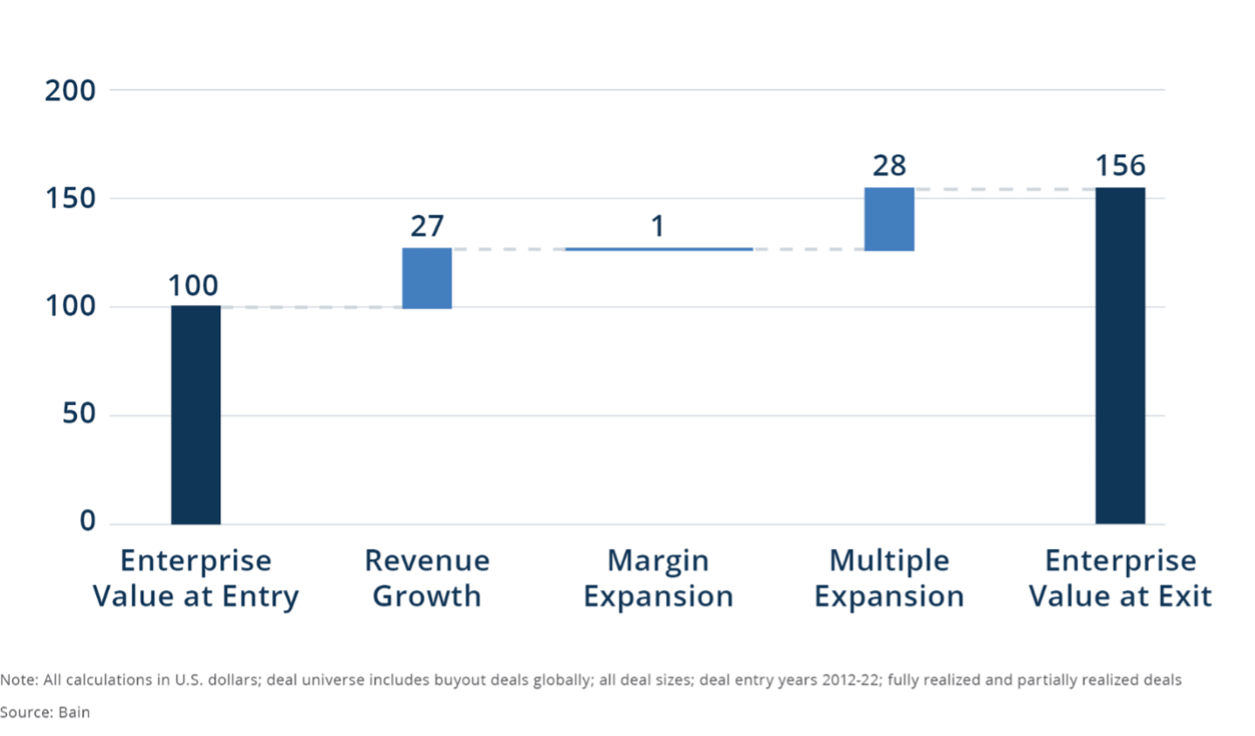
Amplify delivers this balance — combining flexibility with consistent reporting and decision-making at scale.  

3. Outcome-Based Governance

Governance shouldn’t stop at red, amber, green.

Transformation offices are shifting performance reviews to focus on value achieved versus value planned — the true measure of transformation success.

Most transformation tools show what’s being delivered. Amplify shows what value is being created — and sustained.

Benefits realization is not an end-state. Amplify’s outcome-based governance allows leaders to continuously track forecasted vs. realised value, adjust assumptions, and course-correct as transformation conditions evolve.

That’s how organisations move beyond reporting activity to managing sustained business impact.

4. Scalability and Integration for Fast Time to Value

Transformation shouldn’t require months of setup before results appear.

The right platform scales easily, integrates with finance and reporting systems, and delivers fast time to value through intuitive configuration and adoption.

Amplify customers typically achieve visible impact in weeks, not months — a critical differentiator in a market dominated by long implementations.

5. Proven ROI and Enterprise Adoption

Value shouldn’t be theoretical.

The most effective platforms demonstrate clear ROI through faster decision cycles, reduced reporting time, and tighter alignment between goals and realised outcomes.

Amplify customers consistently report faster adoption, clearer accountability, and measurable value across complex transformation portfolios.

Why Use Cases Matter

Features describe what a platform does. Use cases demonstrate what it delivers.

Transformation leaders evaluate through both lenses — capability and context.

The strongest Strategic Program Management platforms make it easy to connect enterprise strategy to measurable outcomes across diverse initiatives, including:

  • Cost Optimisation – Track and sustain efficiency improvements enterprise-wide.
  • Value Creation – Quantify realised benefits, ROI, and financial impact.
  • Post-Merger Integration (PMI) – Align integration programs and synergy tracking under one governance framework.
  • Portfolio Management / Operational Excellence – Optimise investment allocation, prioritise initiatives, and embed continuous improvement.
  • Business Transformation – Govern strategic change programs from planning to measurable impact.
  • New Product Development – Link innovation programs directly to revenue, adoption, and market outcomes.

Amplify’s dynamic Benefits Realization model enables teams to track value trajectories — planned, forecasted, and realised — across all of these primary use cases.

Because transformation value isn’t binary, it must be continuously measured, challenged, and proven.

That’s what separates modern transformation governance from traditional project reporting.

A Better Way to Evaluate

As transformation complexity grows, leaders need more than visibility — they need clarity, speed, and measurable impact.

Next-generation Strategic Program Management software like Amplify enables organisations to align, adapt, and realise value faster — without losing the connection between strategy and execution.

Before comparing features, ask the questions that matter:
• Does the platform connect strategy to measurable value?
• Can it standardise and scale across diverse use cases?
• How quickly can your organisation see impact and ROI?
• Will it improve decision-making speed and confidence?

If the answer is yes, you’re not just buying software — you’re accelerating the success of your transformation.

See the Platform in Action

Discover how leading transformation and strategy teams use Amplify to connect strategy, execution, and measurable impact.

Book a walkthrough to see how Amplify enables organisations to close the loop — turning strategic intent into measurable outcomes, and outcomes into business benefits.

The Real ROI of the Transformation Office: It’s more than just the numbers

The other Half of the ROI Equation

Most ROI conversations start and end with dollars but that only tells half the story. The Transformation Office exists to connect strategy, execution, and value. The other part of the ROI equation comes from accelerating benefits realization, improving governance, and giving leaders the confidence to make decisions that stick.

Bain research shows that companies that track transformation performance systematically are 2.5x more likely to outperform peers on total shareholder return. Yet many organizations still measure success only in financial terms, missing the compounding value of efficiency, transparency, and alignment.

Amplify helps leaders close that gap by connecting financial and non-financial outcomes into one measurable value story.

Where Traditional ROI Falls Short

Transformation efforts often stall when value cannot be proven or communicated. Traditional ROI frameworks struggle to capture the full picture because:

  • Reporting is fragmented. Data lives in dozens of spreadsheets, slide decks, and systems.
  • Intangibles are ignored. Time saved, faster decisions, and improved collaboration are rarely quantified.
  • Value is lagging. By the time financial results show up, the insight comes too late to steer the outcome.

The result is that leaders lose visibility, teams lose focus, and the organization cannot prove what is working or why.

In most large programs, 20 to 30 percent of total transformation time is spent chasing information rather than delivering change. That inefficiency directly erodes ROI.

The Amplify ROI Equation

Amplify helps leaders view ROI through two lenses: the ROI of their programs, and the ROI of the Amplify platform itself.

1. Programs (Powered by Amplify)

Amplify gives organizations the tools to connect initiatives, benefits, and value drivers into one unified performance view. That clarity allows transformation leaders to:

  • Track benefits realization by quantifying planned versus realized value across cost, revenue, and capability metrics.
  • Improve execution velocity by measuring cycle times from decision to delivery.
  • Reduce rework and governance friction by building repeatable performance frameworks that strengthen discipline and accountability.
  • Elevate decision quality by making faster, more confident choices with real-time visibility into performance.

When teams can see how their work contributes to outcomes, performance improves and value compounds across the enterprise.
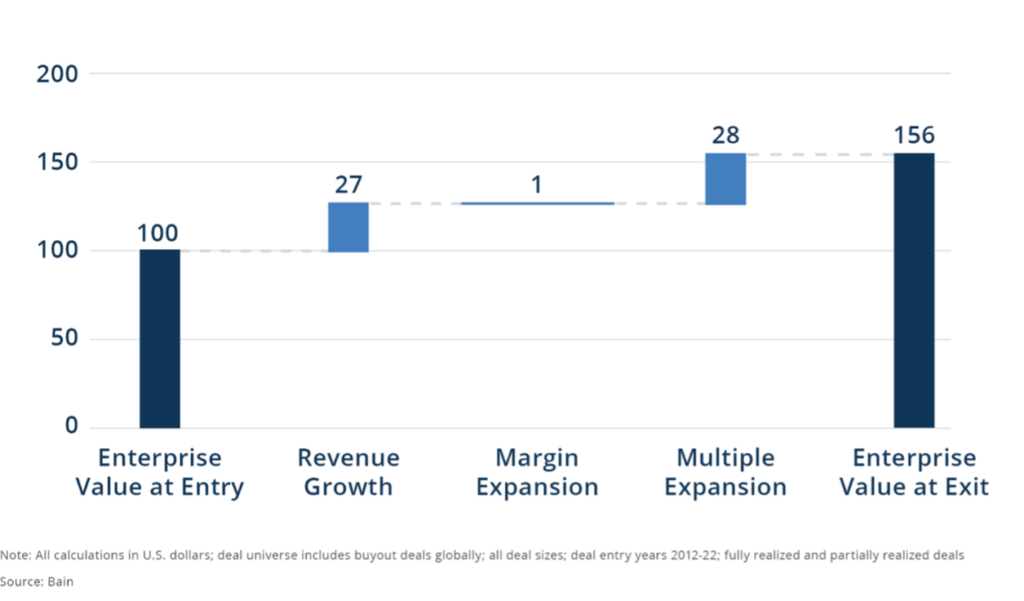
2. ROI on Amplify (the Platform Itself)

Beyond the program results it enables, Amplify delivers direct ROI as a platform investment. Customers see measurable gains in:

  • Reduced manual effort: thousands of hours saved annually by automating reporting and consolidating data.
  • Faster value recognition: real-time tracking surfaces benefits months earlier than traditional methods.
  • Improved decision confidence: one version of truth gives executives the clarity to act decisively.
  • Cultural ROI: greater alignment, ownership, and trust across the organization.

“Amplify paid for itself within the first quarter. The time we saved more than covered the license cost.” – Chief Transformation Officer, Global Manufacturing Organization

Making the Intangible Tangible

Amplify translates what is often invisible – time, effort, alignment – into measurable indicators of value.

Intangible ValueTangible MeasurementExample
Time savedHours x FTE rate1,000 hours saved = $150k equivalent
Faster reportingReduction in cycle timeMonthly reports cut from 10 days to 3
Improved visibilityRisk mitigationPrevented cost overruns on two major projects
Decision confidenceStakeholder survey or adoption rate90% of executives cite “clearer decisions”
Governance upliftFewer missed milestones25% drop in schedule slippage across portfolios

This structure gives CFOs, TransformationOfficers, and PMOs a credible way to quantify intangible ROI and tie it directly to enterprise KPIs.

Building a Value Discipline

ROI should not be an afterthought. It should be designed in from the start.

Leading organizations embed value discipline into every layer of transformation by:

  1. Starting with value hypotheses, defining how each initiative contributes to strategic outcomes.
  2. Building benefits frameworks early, aligning finance and transformation data to track progress.
  3. Integrating value tracking into governance, making benefits realization a standing agenda item.
  4. Communicating outcomes consistently, showing the board and stakeholders what is working and why.

Amplify institutionalizes this discipline, ensuring every initiative is tied to measurable value from inception through realization.

The ROI Mindset

When transformation leaders can quantify both tangible and intangible value, they earn the trust of the board and the confidence of their teams. They move from defending budgets to demonstrating impact.

Amplify helps them get there by turning effort into evidence, and visibility into value.

Contact us to see how Amplify helps organizations quantify transformation ROI – linking efficiency, transparency, and performance to enterprise results.

Summary

Transformation ROI goes beyond numbers. It is the measure of how effectively strategy becomes reality. Amplify helps organizations quantify both tangible (cost, benefits) and intangible (efficiency, governance, decision-making) value to build a clear, credible case for impact.

Sources & Citations

  1. Bain & Company, “The New Rules of Business Transformation,” 2023.
    Organizations that systematically track transformation performance are 2.5x more likely to outperform peers on total shareholder return.
  2. McKinsey & Company, “Why CFOs Need a Bigger Role in Business Transformations,” 2024.
    CFOs who integrate financial and transformation data drive faster value realization and greater investment confidence.
  3. Gartner, “Building a Benefits Realization Framework,” 2022.
    Enterprises that embed benefits realization into governance improve delivery confidence by up to 40%.
  4. Amplify Customer Benchmark Data, 2025.
    Clients report a reduction in time spent on reporting and faster identification of realized benefits across programs.

Optimized Portfolio Management: Driving Value for Portfolio Companies

Driving Value Through Optimized Portfolio Management

For private equity firms, value creation depends on more than financial engineering. The ability to align initiatives, gain real-time visibility, and accelerate execution within portfolio companies is now the key differentiator.

Without the right tools, firms face familiar challenges:

  • Break down silos: Information scattered across departments and systems.
  • Improve visibility: Limited insight for executives, PMO/TMOs, and initiative owners.
  • Eliminate inefficiency: Manual processes that slow reporting, increase errors, and delay decision-making.

These roadblocks limit impact and slow value realization.

The SEM Solution: Empowering Every Level of the Portfolio

A Strategy Execution Management (SEM) platform like Amplify provides a single system of record to manage initiatives, track progress, and prove outcomes. It empowers all key stakeholders:

Executives

  • Gain real-time portfolio visibility: Ensure clear alignment to strategic objectives.
  • Optimize resource allocation: Make data-driven decisions to maximize value.
  • Communicate priorities effectively: Streamline reporting and progress updates.

PMO/TMOs

  • Centralize portfolio management: Manage projects and programs in one system.
  • Track milestones and risks: Identify dependencies early to prevent delays.
  • Standardize execution: Align processes directly with strategic goals.

Initiative Owners

  • Own outcomes clearly: Take responsibility for initiatives and results.
  • Collaborate seamlessly: Coordinate across teams with shared tools.
  • Course-correct quickly: Use on-demand performance data for faster decisions.

The PE Firm’s Strategic Advantage

Recommending or providing an SEM platform to portfolio companies gives private equity firms a distinct edge:

  • Accelerate value creation: Drive operational improvements and growth initiatives more effectively.
  • Enhance oversight: Monitor performance across the portfolio and identify risks or opportunities earlier.
  • Strengthen collaboration: Improve alignment between firm partners, operating teams, and company leadership.
  • Build accountability: Foster a results-oriented culture across all portfolio companies.
  • Standardize execution: Apply repeatable, consistent playbooks across multiple portfolio companies.
  • Capture insights: Build a portfolio-wide database of ideas and proven practices that can be applied elsewhere.

Independent analysis reinforces these advantages: proactive monitoring can identify value creation opportunities months earlier, while disciplined asset allocation can reduce volatility by up to 30%. The result is stronger, more resilient portfolios.

Conclusion: From Execution to Value Realization

Private equity success depends on disciplined, transparent, and accelerated execution. Optimized portfolio management ensures every initiative is aligned with firm strategy and every investment is positioned for long-term value.

With Amplify, portfolio companies can:

  • Align priorities: Ensure direct connection to firm-level strategy.
  • Gain visibility: Access real-time performance data.
  • Accelerate improvements: Deliver operational and growth initiatives faster.
  • Prove outcomes: Demonstrate measurable value creation.

The result: faster execution, stronger returns, and more resilient portfolios.

Watch a demo to see how Amplify helps private equity firms and their portfolio companies realize value sooner.

Private Equity Value Creation: Turning Strategy into Measurable Impact

The Shifting Private Equity Landscape

The era of easy returns through multiple expansion is over. According to a 2023 Brookfield Asset Management report¹, market-driven multiple expansion accounted for most private equity value creation between 2012 and 2022. In today’s volatile environment, that lever is no longer enough.

Private equity firms need a new playbook: one that creates sustainable value through operational excellence and demonstrates strategic impact throughout the investment lifecycle.

CTO reviewing transformation progress charts during year-end planning — symbolising clarity and focus during the festive season slowdown.
Figure1 – Source: Brookfield Asset Management, Private Equity Investing: Improving Operations to Create Value (August 2023).

Creating Sustainable Value in PortfolioCompanies

Delivering superior returns now requires going beyond financial engineering. Private equity leaders must:

  • Align priorities across investors, boards, and management teams.
  • Drive disciplined execution of value creation plans.
  • Build a performance culture that embeds accountability and results.
  • Demonstrate value realization clearly to investors and potential buyers.

Value Creation Across the Investment Lifecycle

1. Onboarding: Laying the Foundation

  • Alignment first: Align value creation priorities with management teams from day one.
  • 100-Day Plan: Develop a structured plan with initiatives, milestones, and ownership.
  • Integration: Connect initiatives with the portfolio company’s management operating system for seamless execution.

2. Asset Management: Driving Execution and Performance

  • Relentless outcomes focus: Track progress against clear financial and operational KPIs.
  • Culture of accountability: Embed performance-driven decision-making and data transparency.
  • Active support: Provide portfolio companies with expertise, networks, and operational guidance.

3. Exit: Showcasing Impact

  • System of record: Maintain a comprehensive record of value creation initiatives.
  • Transparency: Tell a compelling value creation story with evidence to inspire buyer confidence.
  • Data-driven support: Use analytics to validate valuation and highlight realized impact.

Improving Operations to Maximize Value

In today’s market, operational improvements are the most controllable driver of portfolio performance. Firms must think like operators while maintaining the investor’s discipline. This includes:

  • Cash flow discipline
  • Efficiency and productivity gains
  • Risk reduction and resilience building

A Repeatable Playbook for Private Equity Success

A structured, repeatable approach ensures consistency across deals:

  • Comprehensive due diligence: Review business model, competencies, market position, capital allocation, and organization.
  • Structured onboarding: Governance, 100-day plans, management system integration, and customer-centric approaches.
  • Active asset management: Operational experts, value creation initiatives, and cash-flow-focused culture.
  • Well-defined exit strategy: Transparent records, evidence-based value demonstration, and competitive advantage articulation.

The Amplify Advantage for Value Creation

Amplify supports value creation by providing:

  • A single platform for value creation across the investment lifecycle.
  • Real-time visibility into portfolio initiatives, risks, and outcomes.
  • Benefit realization tracking to prove impact beyond financial engineering.
  • A repeatable playbook that embeds discipline, transparency, and performance culture in every portfolio company.

Key Outcomes for Firms That Embrace This Approach

  • Enhanced returns through operational and strategic improvements.
  • Risk reduction by identifying and addressing challenges early.
  • Stronger relationships with portfolio companies and investors.
  • Reputation for excellence that attracts top talent and premium deal flow.

Conclusion: Creating Value Through Discipline and Transparency

Private equity’s future growth lies in operational excellence and transparent value creation. Firms that adopt a proactive, systematic, and repeatable approach—enabled by platforms like Amplify—will not only navigate volatility but also build sustainable reputations for driving strategic impact.

See Amplify in action to explore how leading private equity firms use Amplify to maximize value creation across their portfolios. Request a demo

References

¹Brookfield Asset Management. (2023, August 31). Private Equity Investing: Improving Operations to Create Value. Retrieved fromhttps://www.brookfield.com/news-insights/insights/private-equity-investing-improving-operations-create-value

Solution Use Case: Goal Prioritization and Transformation Value at Scale

The Challenge: Scaling Transformation Across Complex Enterprises

For global enterprises with multiple locations and thousands of employees, transformation success often hinges on one question: “Are we working on the right priorities, and are they delivering the value we expect?”

Many organizations face the same barriers: fragmented reporting across spreadsheets, SharePoint, and local systems, manual consolidation of data consuming valuable time each month, limited visibility for executives and boards into whether initiatives are creating measurable business impact, and employee frustration with reporting overhead that pulls focus away from delivering results.

The Solution: Amplify for Transformation Offices

Amplify provides a unified platform to simplify complexity, connect strategy to outcomes, and prove value realization.

By using Amplify, transformation leaders can:

  • Consolidate initiatives from dozens or even hundreds of programs into one “command center” view.
  • Eliminate manual reporting by capturing data directly from initiative owners.
  • Enable executive visibility into progress, risks, and realized value.
  • Create a culture of accountability with role-based dashboards and ownership.

Implementation in Practice

Transformation Offices that succeed with Amplify follow a consistent pattern:

  1. QuickStart implementation: Accelerate time to value with a resource-light approach, using best practice accelerators and adopting the out-of-the-box version before custom configuration.
  2. Train and reinforce: Build confidence and alignment through early workshops and ongoing enablement.
  3. Iterate and adapt: Adjust dashboards, maps, and reporting as leadership needs evolve.
  4. Partner Continuously: Leaning on Amplify’s account team for support, Q&A, and best practices.

This approach builds adoption, reduces resistance, and accelerates the path to measurable results.

Business Impact

With Amplify, transformation offices can:

  • Improve productivity: Make hundreds of site-level initiatives visible, measurable, and linked to P&L outcomes.
  • Track value in real time: Give executives and finance teams clear visibility into whether planned efficiencies and savings are being delivered.
  • Accelerate reporting cycles: Replace days of manual consolidation with automated dashboards for monthly board and leadership reviews.
  • Strengthen decision-making: Free leaders from data crunching so they can focus on solving problems.

Lessons Learned for Transformation Leaders

Organizations adopting Amplify consistently highlight three success factors:

  1. Embed change management: Position Amplify as part of the transformation strategy, not just a tool rollout.
  2. Build champions early: Empower early adopters to support peers and drive adoption across sites.
  3. Think beyond reporting: Use Amplify to shape priorities, track benefits, and create a value-driven culture.

Conclusion: From Reporting to Realization

This solution use case demonstrates how Amplify enables large, complex organizations to move from fragmented reporting to confident value realization.

For transformation offices, the message is clear: success isn’t about collecting updates, it’s about proving outcomes. Amplify provides the platform, theprocess, and the support to make that shift a reality.

See Amplify in action – discover how transformation leaders are using Amplify to prioritize what matters and deliver measurable value.

Strategy Execution Guide

Why Strategy Execution Still Fails

Even the best strategies falter when execution breaks down. Common challenges include:

  • Teams misaligned on goals and priorities
  • Limited visibility into initiative progress
  • Difficulty adapting as conditions shift
  • Siloed reporting that consumes time but adds little value

For Transformation Offices and enterprise leaders, these hurdles highlight the need for more than project tracking. What’s required is a flexible, transparent, and outcomes-focused platform that can adapt as priorities evolve.

Amplify: Built for Strategy Execution That Delivers

Challenge: Misaligned Teams and Unclear Priorities

How Amplify Helps: Amplify creates a single source of truth for priorities and outcomes. By centralizing communication and providing customizable governance, teams can break down silos, align on what matters most, and stay accountable to strategic objectives.

Challenge: Limited Visibility into Progress

How Amplify Helps: Amplify gives leaders real-time visibility across both financial and non-financial goals, including sustainability, operational efficiency, and employee engagement. Clear dashboards and reporting support faster, more confident decision-making.

Challenge: Struggling to Adapt to Change

How Amplify Helps: Amplify’s flexible, no-code environment allows organizations to reconfigure as strategies shift. Whether adapting to market changes, seizing new opportunities, or responding to disruption, Amplify helps leaders pivot without losing momentum.

Why Amplify Stands Out

  • Align Teams, Achieve Clarity: Centralize communication, unify priorities, and provide a shared understanding of strategy execution.
  • Gain Real-Time Visibility: Access initiative progress, resource allocation, and potential risks with clarity, driving proactive decisions.
  • Adapt with Confidence: Quickly adjust priorities and governance models as needs evolve, without complex rework.
  • Seamless Integration: Amplify integrates with existing practices and systems, ensuring smooth adoption and maximum value from day one.

Amplify’s NPV Dashboard showing planned vs forecasted vs actual performance across multiple programs.

Key Takeaways

  • Amplify fosters alignment and accountability across teams.
  • Amplify provides real-time visibility into both financial and non-financial goals.
  • Amplify empowers organizations to adapt quickly and confidently.

Embracing the Future of Strategy Execution

Strategy execution isn’t static. Transformation leaders need tools that are as dynamic as their challenges. Amplify offers a comprehensive platform designed for flexibility, visibility, and confidence in outcomes.

Whether you’re replacing spreadsheets, transitioning from another tool, or seeking a more comprehensive approach to transformation, Amplify helps you:

  • Prove value realization
  • Reduce execution risk
  • Drive sustainable impact

Request a personalized demo to see how Amplify can help your Transformation Office deliver clarity, adaptability, and measurable results.

The Executive Guide to Benefit Mapping

Why Benefit Mapping Matters in 2025

Strategic transformations remain high stakes, yet nearly 80% still fail to deliver on their promises. The reasons haven’t changed: lack of transparency, poor alignment, and limited ownership.

Benefit mapping is one of the most effective ways to reverse that trend. It gives transformation leaders—Chief Transformation Officers, Chief Strategy Officers, and their teams—a visual and disciplined way to connect strategic objectives with the outcomes and benefits that matter most.

What Is Benefit Mapping?

Benefit mapping acts as the GPS for transformation offices. It connects investment objectives to the initiatives, outcomes, and benefits that deliver measurable value.

With a benefit map, you can:

  • Prioritize what matters: Spotlight the initiatives that truly move the needle.
  • Eliminate waste: Avoid pet projects that drain resources.
  • Stay accountable: Track progress and adjust course as conditions change.

Best practice: begin benefit mapping early in your transformation planning cycle, not as an afterthought.

Two Proven Techniques

1. Benefit Pathway

A collaborative method designed to diagnose the real business problems and map the changes needed to address them.

Steps:

  1. Assess the current state and pain points.
  2. Identify changes required (start/stop/continue).
  3. Analyze impacts (positive and negative).
  4. Define the benefits that will flow.

Why it works: It ensures you’re solving causes, not symptoms, and builds shared commitment across stakeholders.

2. MSP Technique (Managing SuccessfulPrograms)

A structured approach recognized globally,MSP benefit maps show cause-and-effect linkages from project outputs → business capabilities → outcomes → benefits → strategic objectives.

Strengths:

  • Visual clarity on dependencies.
  • Alignment with investment objectives.
  • Easier measurement of ROI.


Best Practices for Benefit Mapping

  • Collaborative workshops: Whether in person or virtual, engagement is key. Tools like Amplify enable real-time, multi-stakeholder input.
  • Choose the right technique: Pathway for diagnosing problems, MSP for mapping dependencies.
  • Leverage technology: Static PowerPoints aren’t enough. Enterprise software like Amplify brings maps to life with drilldowns, dashboards, and ownership.


How Amplify Elevates Benefit Mapping

Unlike generic tools, Amplify is purpose-built for transformation offices.

With Amplify you can:

  • Drill down: See every dependency between objectives, projects, and benefits.
  • Track in real time: Dashboards for costs, risks, dependencies, and timelines.
  • Plan realization: Create Benefit Realization Plans (BRPs) that define measurable outcomes, owners, and projected value.
  • Prove ROI: Demonstrate how strategy turns into outcomes with hard numbers.


Why It Matters for Transformation Offices

Benefit mapping with Amplify addresses the top three barriers to transformation success:

  1. Transparency: Everyone sees the same map of objectives, initiatives, and benefits.
  2. Alignment: Executives and initiative owners commit to the same outcomes.
  3. Value realization: Leaders can finally prove impact on cost savings, efficiency, or revenue growth.


Conclusion

Benefit mapping isn’t just a planning exercise.It’s the discipline that gives your Transformation Office the credibility and visibility to steer the enterprise. Done right, and supported by Amplify, it becomes the difference between reporting progress and proving outcomes. See Amplify in action – explore how transformation leaders use Amplify to bring benefit maps to life and accelerate value realization.