

Is Accelerating Execution. But Is it Creating Lasting Value?
AI is already reshaping how transformation is executed across the enterprise. Activities that once required significant manual effort—such as analysis, reporting, and forecasting—are becoming faster, more automated, and increasingly continuous. As a result, the cost and effort associated with execution are falling, and organizations are able to move with greater speed and responsiveness than before.
However, this shift does not reduce the need for transformation discipline. In practice, it increases the pressure on organizations to ensure that execution translates into measurable outcomes. As the pace of activity rises, so too does the likelihood that effort becomes disconnected from value, with more initiatives in motion but less clarity on whether they are collectively delivering the intended impact.
Execution can now move faster than ever, but speed alone is not the objective. The challenge is ensuring that execution remains aligned, coordinated, and ultimately tied to value creation.
Transformation Has Always Been a System Challenge
In most organizations, the barrier to successful transformation has rarely been a lack of insight. Leadership teams are generally clear on where costs need to be optimized, which growth initiatives matter, and what value should be delivered over time. The strategic intent is often well understood.
Yet outcomes still fall short of expectations.
This gap exists because transformation is not delivered through isolated initiatives. It is delivered through a system of execution that connects priorities, aligns resources, and governs how decisions are made across the enterprise. When that system lacks structure, breakdowns occur in ownership, prioritization, and coordination, often long before they are visible in reporting or financial outcomes.
AI improves the quality and speed of insight, but it does not resolve how that insight is translated into coordinated action across a complex organization. That challenge remains fundamentally structural.
Speed Introduces a New Form of Risk
One of the most significant shifts AI introduces is the acceleration of execution across multiple fronts simultaneously. Organizations can initiate more work, generate more signals, and respond to changes with increasing speed, often across multiple programs and functions at once.
This creates a different kind of risk—one that is less about inactivity and more about misalignment.
As the volume and velocity of activity increase, maintaining alignment becomes more complex. Priorities can shift faster than they are governed, dependencies can be overlooked as initiatives evolve, and resources can be distributed across competing efforts without clear trade-offs being enforced. Over time, this leads to a dilution of focus, where a high level of activity masks a lack of coherent progress.
Sustaining alignment at speed requires more than faster tools. It requires a defined structure for how execution is coordinated, governed, and continuously adjusted across the enterprise.
AI Is Challenging the SaaS Model — But Not All Software Is Equal
There is growing discussion that AI will fundamentally reshape the SaaS landscape. As AI becomes more capable, the way users interact with software is already changing, with less reliance on traditional interfaces and more emphasis on AI-driven workflows. In this model, certain application layers become less distinct, and some may become interchangeable or redundant over time.
There is validity in this perspective. AI is reducing the need for software that primarily exists to capture, retrieve, or summarize information, particularly where those tasks can be handled more efficiently through intelligent agents.
However, this view assumes that all software serves the same purpose, which is not the case.
Some software exists to facilitate individual tasks. Other software exists to structure how the enterprise operates as a system. The distinction between these roles is increasingly important.
Transformation is not a collection of independent tasks. It is a coordinated system of decisions, dependencies, governance, and value realization that spans the enterprise. As AI accelerates individual activities, the need for a system that maintains alignment, enforces accountability, and connects execution to value becomes more critical. This is the layer that enables organizations to translate activity into outcomes, and it is not something AI replaces. It is something AI depends on.
The Transformation Office Becomes Structural
In this context, the role of the Transformation Office continues to evolve. It is no longer limited to coordinating programs or tracking progress. Its role is increasingly centered on defining how execution operates as a system across the organization.
This includes establishing how strategy is translated into portfolios, how priorities are evaluated and rebalanced, how governance is embedded into decision-making, and how value is tracked and validated over time. These are not administrative tasks, but structural elements that determine how effectively an organization can deliver change at scale.
As execution accelerates, the need for this structure becomes more pronounced. The Transformation Office becomes the mechanism through which alignment is maintained, decisions are governed, and outcomes are realized in a consistent and repeatable way.
Why AI Cannot Replace This Role
AI plays an important role in improving how decisions are informed, particularly by increasing visibility, surfacing risks, and enabling faster analysis. However, the responsibilities associated with transformation extend beyond insight and recommendation.
Decisions within transformation programs carry financial and strategic consequences. They involve trade-offs between competing priorities, the allocation of limited resources, and the accountability of leaders for delivering outcomes. These decisions are shaped at the C-suite level, where priorities across functions must be aligned, risks evaluated, and trade-offs actively managed in the context of broader organizational objectives.
Ensuring alignment at this level requires structure, governance, and clearly defined accountability across the leadership team.
At the same time, transformation depends on a consistent and reliable view of execution across the enterprise. Without a structured system that connects initiatives, benefits, and dependencies, data becomes fragmented and difficult to reconcile, reducing confidence in reporting and slowing decision-making.
AI can support visibility and highlight emerging risks, but ensuring that risks are addressed, priorities are enforced, and value is realized requires a system designed for execution.
The Missing Layer: Execution Architecture
What this shift makes increasingly clear is that many organizations are operating without a defined execution layer. While strategy may be clearly articulated and delivery tools are widely used, the structure that connects these elements into a coherent system is often missing.
Execution architecture addresses this gap. It provides the structural integration required for enterprise strategy execution and value creation by defining how strategic intent is translated into portfolios of work, how governance and funding decisions are applied, how delivery is coordinated across functions, and how value is measured and realized over time.
By bringing these elements together into a single operating layer, execution architecture enables consistent, enterprise-wide execution. As organizations adopt AI more broadly, the importance of this layer becomes increasingly visible. AI increases the speed at which execution can occur, but execution architecture determines whether that speed contributes to meaningful value creation.
Where Amplify Sits
Organizations that recognize this shift are focusing on how execution is structured, rather than simply how it is accelerated.
This is where Amplify sits.
Amplify is the execution architecture for enterprise strategy execution and value creation. It brings together strategic alignment, portfolio structure and accountability, governance and funding control, cross-functional delivery coordination, and value realization and performance insight into a single operating layer.
By providing this structure, Amplify enables organizations to connect priorities, embed governance, and maintain visibility across the transformation portfolio. It creates a shared system of truth in which decisions are informed, aligned, and accountable, allowing execution to be managed consistently at an enterprise level.
In this role, Amplify is not an additional tool within the stack, but the layer through which execution is defined and sustained.
The Shift That Matters
Organizations that succeed in this environment will be those that can integrate AI into a coherent system of execution. They will be able to maintain alignment as the pace of change increases, govern decisions with clarity, and ensure that value is continuously tracked and realized.
AI expands what is possible in transformation, but outcomes are ultimately determined by how effectively execution is structured and managed.
Final Thought
AI changes how fast organizations can execute.
C-suite alignment and execution architecture determine whether that speed delivers value.
Explore how leading organizations are structuring execution to deliver measurable transformation outcomes.
→ Enterprise Transformation Maturity Report
Or read the first blog in our Enterprise Transformation & AI series: AI Won’t Eliminate Transformation — But It Will Change How Its Done
What We Learned from Enterprise Transformation Leaders — And Why It Changes How Value Is Delivered
Enterprise transformation has evolved.
Organizations can no longer deliver change through a series of discrete programs. Instead, they are managing multiple, overlapping initiatives— cost optimization, organic and inorganic growth, operational improvements, innovation — concurrently and continuously.
In this context, transformation can no longer be executed periodically. It needs to be a continuous capability for delivering value across the enterprise.
This is the shift at the center of what we describe as Transformation 4.0 — where execution evolves from a series of initiatives into a core enterprise capability for value creation.
The Enterprise Transformation Maturity Report 2026
To understand how organizations are responding to this shift in practice, we commissioned independent research to interview transformation leaders responsible for executing enterprise-scale change inside large global organizations.
These are individuals operating at the center of execution — managing complex portfolios, coordinating cross-functional delivery, and accountable for delivering measurable outcomes in dynamic environments.
The findings are presented in the Enterprise Transformation Maturity Report 2026. What emerges is not a set of isolated challenges, but a clear pattern of structural change.
This shift is best understood through the lens of execution maturity — as the progression of how effectively an organization connects strategy, execution, and value over time.
Transformation Is Shifting to a Continuous Operating Model
One of the most significant changes is the breakdown of transformation as a clearly defined phase.
Organizations are no longer moving cleanly from strategy to execution and then returning to business-as-usual. Instead, they are operating in a state where multiple forms of change are happening concurrently and continuously. Cost optimization, growth initiatives, operational improvement, and innovation are no longer sequenced — they are interdependent and ongoing.
Transformation, therefore, is no longer something that is initiated and completed. It is becoming embedded within the operating model of the organization itself.
Portfolio Scale Has Increased Faster Than Execution Capability
At the same time, the scale and complexity of transformation portfolios have expanded significantly.
Most organizations are now managing large numbers of initiatives across multiple programs and workstreams, often spanning functions, geographies, and strategic objectives. Investment levels are substantial, and expectations around delivery are high.
However, while portfolios have grown, the capability required to manage them effectively has not always kept pace. Many organizations continue to rely on fragmented tools, disconnected processes, and periodic governance cycles to manage increasingly dynamic environments. Prioritization remains episodic rather than continuous, and trade-offs are not always made with full visibility of enterprise impact.
The result is a structural imbalance: greater scale without a corresponding increase in execution maturity.
“What this research makes clear is that while many organizations are operating at scale, far fewer have developed the maturity required to manage that scale as a true enterprise capability.”
Value Is the Objective — But Not Yet Systematically Delivered
There is a clear shift toward value as the primary measure of transformation success.
Organizations are increasingly focused on outcomes — financial impact, strategic progress, and enterprise performance — rather than activity alone. Business cases are developed, targets are defined, and expected benefits are articulated at the outset.
However, the ability to consistently deliver and protect that value remains uneven. Benefits are often strongest at the point of approval but become diluted as initiatives progress. Changes in scope, delays in delivery, and shifting priorities all contribute to erosion over time. In many cases, value is reported retrospectively rather than actively managed during execution.
This gap between intent and outcome remains one of the most persistent challenges observed across organizations.
Execution Has Become the Limiting Factor
Across all discussions, one theme emerged consistently: execution is now the primary constraint on transformation success.
Organizations are not lacking in strategic intent, and in many cases, they are not lacking in investment. What they are struggling with is the ability to consistently translate that intent into outcomes — coordinating across functions, making timely decisions, maintaining accountability, and adapting as conditions change.
These are not isolated issues. They reflect execution capabilities that have not evolved to match the scale and complexity of modern transformation.
A Different Model Is Beginning to Emerge
While many organizations are still navigating these constraints, a smaller group is beginning to operate differently.
Rather than treating transformation as a layer on top of the business, they are building execution as an integrated, enterprise capability. This involves connecting strategy, investment, delivery, and value into a single, coherent system.
In these organizations, execution is supported by continuous prioritization, clearer accountability, and more direct links between decisions and outcomes. The focus shifts from managing transformation activity to managing enterprise performance.
From Transformation Programs to Continuous Value Creation
Taken together, these findings point to a broader evolution in how transformation is understood and executed.
Organizations are moving beyond managing transformation as a series of programs and toward building the capability to deliver value on an ongoing basis. This progression can be understood in three stages — from programs, to portfolios, to continuous value creation — each requiring a higher level of maturity across how the organization operates.
Each stage reflects a different level of maturity — not only in processes and tools, but in how the organization operates as a whole.
The Future of Transformation
It is evolving into a continuous, enterprise-wide capability that connects strategy, execution, and outcomes in real time. In this model, value is no longer created through isolated initiatives, but through the organization’s ability to consistently translate intent into results; to allocate capital effectively, adapt as conditions change, and protect value as it is created.
This is not an incremental shift in how transformation is managed. It is a fundamental revolution in how value is delivered across the enterprise.
Organizations that recognize this — and build the capability to operate this way — will lead the next generation of enterprise value creation.
Read the Full Report
The Enterprise Transformation Maturity Report 2026 provides a detailed view of how leading organizations are evolving their approach to transformation, where gaps remain, and what distinguishes those that are progressing from those that are not.
Read the full report to understand how enterprise transformation is changing — and what it takes to operate at the next level.
How Mature Organizations Dynamically Allocate Budgets Across Enterprise Transformation

AI Isn’t Replacing Enterprise Transformation – But It Will Redesign How It Works

The question everyone is asking — and getting wrong
There’s a question that’s coming up in almost every conversation I’m having right now, whether that’s with prospects, existing customers, or transformation leaders who are trying to work out how AI fits into what they’re doing.
It’s usually framed in a fairly direct way:
What is the value of the transformation office in the AI age?
It’s a fair question, and you can understand why people are asking it. Transformation teams are under more pressure than ever. Expectations are increasing, programs are getting more complex, and at the same time, resourcing is becoming more constrained.
But it’s also the wrong question.
Because the underlying issue most organizations are dealing with isn’t whether they have the right strategy or even the right ideas. In most cases, they do. The issue is whether they have the capacity to turn those ideas into something that actually delivers value.
One of our customers summed it up better than I could. He said, “I need a team of ten in my transformation office. I’ll probably get two.” That gap between ambition and capacity is where most transformations start to slow down.
The real constraint isn’t a clear strategy, it’s execution capacity
When you look more closely at how transformation actually plays out inside organizations, a pattern emerges quite quickly.
Strategy is rarely the problem. The thinking is often sound, the priorities are clear, and the intent is there. Where things start to break down is in the ability to execute consistently and at scale.
Initiative owners don’t always get the support they need to shape ideas properly. Transformation teams become stretched across too many priorities. Processes that should take days extend into weeks because they rely on a small number of experienced individuals who quickly become bottlenecks.
It’s not unusual to see it take eight to twelve weeks to move from an initial idea to something that is fully defined, validated, and ready to move forward. Not because the work itself is inherently complex, but because the system around it is slow, manual, and capacity-constrained.
That’s the constraint. And it’s exactly where AI starts to become meaningful.
The real role of AI: removing friction, not replacing judgment
There’s a lot of noise at the moment about AI replacing jobs, and in the context of transformation, that conversation tends to focus on whether parts of the transformation office can be automated.
From what we’ve seen, that framing misses the point.
The parts of transformation that actually determine outcomes — judgment, trade-offs, accountability — are not things you can or should automate away. Transformation is not purely analytical. It depends on context, experience, and the ability to make decisions under uncertainty.
At the same time, a significant portion of the work that surrounds those decisions is repetitive, time-consuming, and often frustrating for the people doing it.
Structuring business cases, gathering and validating data, following up on updates, ensuring governance requirements are met — all of this work is necessary, and it often requires skilled people. But it is also repeatable.
That distinction matters.
Because repeatable work is where AI can create real leverage. Not by replacing people, but by removing friction from the system they operate within.
Why the model is shifting: from capability gaps to embedded guidance
When we first built Amplify, our assumption was that transformation offices were relatively mature. That they had experienced teams, well-defined processes, and what they needed was better tooling to connect everything together.
What we’ve seen over time is a different reality.
There are fewer experienced transformation leaders than many organizations assume, and at the same time, the number of transformation programs has increased significantly. The result is a capability gap. Organizations are trying to run increasingly complex programs without the depth or capacity to support them properly.
That’s why the conversation has shifted.
Customers are no longer just asking for software. They’re asking for guidance. They want structure. They want to know that the way initiatives are being defined, governed, and executed reflects best practice.
Increasingly, they’re asking whether that guidance can be embedded directly into the system, rather than relying on a small number of individuals to provide it manually.
From tooling to embedded intelligence
At Amplify, that shift is shaping how we’re approaching AI.
We’re not interested in adding AI as a layer on top of existing workflows or introducing features for the sake of it. The focus is on where intelligence can genuinely improve how execution happens.
In practical terms, that means embedding intelligence into the process itself. Instead of asking people to complete forms and then validating them later, the system can guide them as they work. Our agents are designed to help structure thinking, challenge assumptions, and ensure that key requirements are met at the point of entry.
The effect of that is not just speed, although that matters. It’s also consistency. It’s data quality. It’s reducing the reliance on already stretched transformation teams to catch issues after the fact.
We’re taking a similar approach more broadly, thinking about how different parts of the transformation office can be supported by purpose-built capabilities that work alongside people, rather than replacing them. It’s an area we’re investing in heavily, but deliberately, with a focus on where it adds real value rather than where it simply sounds compelling.
How we think about AI in transformation
At a practical level, the way we think about AI in transformation is not as a feature or a capability, but as part of a system.
We see transformation as a continuous loop that connects four things: data, judgment, recommendations, and decisions. Each of these depends on the others. Better data leads to better judgment. Better judgment leads to better decisions. Better decisions generate better data.
It’s not a linear process. It’s a cycle.
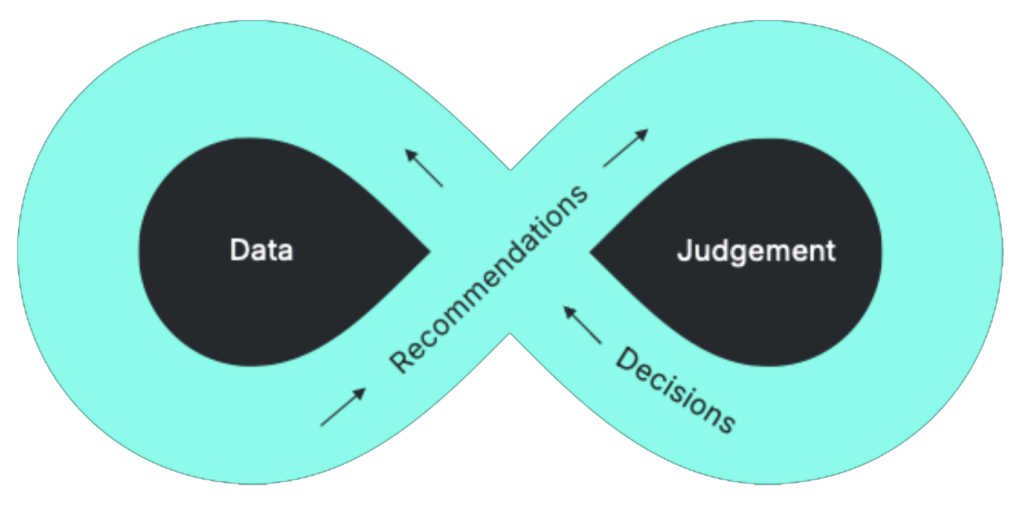
AI strengthens parts of this loop. It improves the quality and availability of data, and it accelerates the generation of insight and recommendations.
But it doesn’t replace the need for judgment, and it doesn’t remove accountability for decisions.
Those are the points in the loop where context, experience, and trade-offs matter most. They’re also the points where transformation succeeds or fails.
So rather than trying to take people out of the process, the goal is to strengthen the loop itself — using AI to improve the flow from data through to decisions, while keeping humans firmly responsible for the outcomes.
Why context matters more than capability
One of the most useful pieces of feedback we’ve had recently came from a customer who said that none of this works unless the system understands how they operate.
Their stage gates, their financial principles, their definitions of value — these things vary between organizations, and they matter. Without that context, even the most capable AI will produce outputs that are technically correct but practically unhelpful.
That’s the difference between generic AI and applied AI.
Generic AI can generate answers. Applied AI needs to reflect the operating model of the organization it sits within. In transformation, where governance, value, and accountability are tightly defined, that context is not optional. It’s fundamental.
What a modern transformation office looks like
If you follow this through, the implication is not that transformation offices disappear, but that they change.
The traditional model is heavily dependent on people and can be difficult to scale. As programs grow in size and complexity, the demand for support grows with them.
A more modern approach is leaner and more intelligent. Systems take on more of the coordination, data handling, and repeatable work, while people focus on prioritization, trade-offs, and leadership.
The practical impact of that is significant. Planning cycles shorten. Data quality improves. Governance becomes more consistent. And teams are able to support larger programs without a linear increase in headcount.
The shift that matters
AI will change transformation. That’s already happening.
But the organizations that benefit most won’t be the ones that rush to automate everything or layer AI onto existing processes.
They’ll be the ones that take a step back and rethink how execution actually works. Where the friction is. Where capacity is being consumed. And where intelligence can genuinely improve the system.
Because this isn’t about adding AI into transformation, it’s about redesigning how transformation is executed.
And that’s a much bigger shift.
Explore how modern transformation teams are redesigning execution →