
Amplify-Now

When Disruption Is Continuous, Your Transformation Portfolio Becomes a Strategic Asset — or a Liability 

What this article covers

  • Why disruption is no longer episodic — and what that means for transformation
  • What most organizations get wrong when responding under pressure
  • The four portfolio decisions leaders must be able to make quickly
  • Why a Transformation Office enables structured, confident response

Introduction

Transformation is no longer executed in stable conditions. 

For many years, organizations operated under the assumption that strategy could be defined, funded, and delivered over multi-year horizons with a reasonable degree of predictability. That assumption has now broken down. What was once a sequence of discrete shocks has become a continuous operating environment shaped by geopolitical instability, economic volatility, and shifting global trade dynamics. 

We are not moving from one disruption to the next. We are operating in a state of sustained uncertainty. 

The next shock is not clearly visible, but it is increasingly inevitable. Whether driven by geopolitical escalation, economic dislocation, or structural shifts in global markets, organizations should expect further disruption rather than a return to stability. 

In this environment, transformation portfolios are no longer tested occasionally — they are tested continuously. The challenge for leadership teams is not simply how to respond to disruption, but how to do so without dismantling the programs that are intended to carry the organization forward. 

In this CTO Insights article, Christian Patten explores how organizations respond under pressure, and why those with a structured transformation capability are able to make deliberate decisions, while others default to reactive ones that erode value and momentum. 

The Shock Is Already Here 

We are living in an era of compounding disruption. 

COVID-19 forced organizations to freeze entire transformation portfolios overnight, often without a structured basis for deciding what to stop, what to slow, and what to protect. In the years since, geopolitical instability — from the war in Ukraine to energy market volatility and supply chain fragmentation — has continued to reshape capital allocation, resource availability, and risk exposure. More recently, shifts in global trade and regional tensions have introduced further uncertainty into already complex operating environments. 

What is notable is not just the severity of these events, but their frequency. 

The gap between disruptions has narrowed to the point where stability can no longer be assumed. Organizations that treated earlier events as isolated were quickly confronted by what followed. 

The pattern is no longer cyclical. It is structural. 

What Most Organizations Get Wrong 

When a shock hits, most organizations do not stop. They continue — but what they continue is activity, not decision-making. 

Governance forums still meet. Status reports still circulate. Program leaders continue to report progress. But the critical questions — what should be stopped, what should be protected, and what should be accelerated — often go unanswered, because there is no structured mechanism to answer them. 

Resources are reallocated based on urgency and visibility rather than evidence. Programs that should be accelerated — because they directly address the conditions created by the disruption — are paused alongside those that were already marginal. 

The organization ends up producing motion without momentum, neither responding effectively to the shock nor progressing the transformation agenda. 

This is not a failure of intent. It is a failure of structure. 

“Leaders, specialists, and delivery teams hold institutional knowledge, stakeholder relationships, and execution momentum. When a shock occurs, demand on these individuals increases immediately.”

What a Transformation Office Makes Possible 

Organizations with a functioning Transformation Office respond differently. 

Rather than reacting immediately, they begin with a structured review of the portfolio. The portfolio provides a clear view of what is in flight, what each program is consuming in resources, what the expected return is, and how initiatives are interconnected. 

From this position, leadership teams are able to make four critical decisions with greater clarity. 

They can identify what can be paused, preserving work in a controlled state so that it can be reactivated efficiently when conditions allow. They can determine what needs to be rescoped, reducing complexity or resource intensity without losing the core investment already made. They can decide what should be stopped, where the strategic rationale no longer holds or the return no longer justifies the cost. And they can recognize what should be accelerated, where the disruption has increased the urgency or value of specific initiatives. 

These decisions are not simple, but they are significantly better when made from a structured, evidence-based view of the portfolio than when made under pressure without one. 

When leadership operates with a shared view of the portfolio and a clear decision cadence, the nature of the response changes. The shock becomes a leadership moment rather than a reactive exercise. 

The Resource Intelligence Advantage 

In periods of disruption, the most constrained resource is not capital. It is capability. 

Leaders, specialists, and delivery teams hold institutional knowledge, stakeholder relationships, and execution momentum. When a shock occurs, demand on these individuals increases immediately. 

Organizations with a functioning Transformation Office understand where this capability sits. They know which initiatives depend on it, what trade-offs are required to redeploy it, and what impact those decisions will have on delivery. 

This enables deliberate, targeted reallocation rather than reactive reshuffling. 

The financial dimension is equally important. When portfolio decisions are made in a structured way, the impact on funding and cost is clearer. Programs that are paused or stopped release capacity and capital in a way that can be understood and redeployed, rather than being absorbed into organizational inertia. 

The result is an organization that can absorb disruption without losing the capability or momentum it has already built. 

This Is Becoming a Defining Capability 

‍The frequency of external disruption is increasing, and the period of relative stability that once supported long-term transformation programs is no longer reliable. 

For leadership teams, this changes what matters. 

A transformation portfolio without the ability to review, reprioritize, and reallocate quickly is not simply inefficient. It creates risk. 

The capability that differentiates organizations is not scale or complexity. It is clarity on what is in the portfolio and why, cadence that supports timely decision-making, and confidence that when conditions change, the organization can respond deliberately rather than reactively. 

The question is straightforward: if a shock arrived tomorrow, would you be reviewing your portfolio, or reacting to it? 

That capability does not emerge in a crisis. It is built before one. 

Final Thought

The operating environment for transformation has changed fundamentally. 

Disruption is no longer an exception. It is an ongoing condition. 

In this context, transformation portfolios must be designed to adapt without losing direction. They must be capable of flexing under pressure while maintaining alignment and momentum. 

The organizations that succeed will not be those that avoid disruption. They will be those that can respond to it without dismantling their own progress. 

Because when the next shock arrives — and it will — execution is what determines whether transformation holds or fragments. 


About the Authors

Genevieve Smith is VP Global Marketing at Amplify-Now, where she leads the company’s global brand, positioning, and go-to-market strategy. With over 20 years’ experience in the tech industry spanning PE-backed SaaS, large multinationals, and sales and marketing consulting, she brings deep expertise across strategic marketing disciplines. Genevieve is passionate about elevating the role of the Transformation Office and helping organisations connect strategy, execution, and measurable impact.

Guest CTO: Christian Patten is a Transformation and Strategy Leader with over 25 years of experience driving organisational performance across aviation, financial services, health, and government. As former Chief Transformation Officer at Airservices Australia, he led a $3.5B transformation that delivered more than $100M in performance uplift while maintaining operational excellence and safety. Today, as Managing Partner at Forbes & Company, Christian works with boards and executive teams to design and execute transformations that balance purpose with performance.


CTO Insights: Stakeholder Management in Transformation

What this article covers

  • Why 70% of transformations fail — and why stakeholder alignment is the real issue
  • The three stakeholder domains every transformation must actively manage
  • Why cadence, narrative alignment, and governance determine transformation success
  • That CEOs, CTOs, and senior leaders must do differently to sustain stakeholder confidence

Introduction

Most transformation failures are blamed on strategy.

In reality, strategy is rarely the problem.

Most transformation programs begin with thoughtful planning, credible financial models, and capable delivery teams. Yet despite this preparation, the majority fail to achieve their intended outcomes.

The reason is almost always the same.
Stakeholders were never fully aligned, and when alignment breaks down, value inevitably erodes across the transformation lifecycle.

Stakeholder management is still treated as a communications exercise — a sequence of updates explaining decisions that have already been made.

But transformation is not a messaging challenge.

It is a governance challenge.

When stakeholder engagement is treated as infrastructure — structured, integrated, and disciplined — transformation accelerates. When it is improvised, resistance grows, confidence erodes, and execution stalls.

In this CTO Insights article, Christian explores the three stakeholder domains every transformation must manage, and why clarity, cadence, and narrative alignment are essential to sustaining momentum.

Most transformations don’t fail because of the strategy

They fail because leaders treat stakeholder management as a communication task — not a strategic discipline.

McKinsey’s research is clear: 70% of transformation initiatives fail, and the primary cause is not strategy design or funding.

It is people.

More precisely, it is the failure to engage the right stakeholders, with the right message, at the right cadence, across the full ecosystem of the enterprise.

Too often, stakeholder management is introduced after the transformation architecture is defined — a communications plan added late in the process.

The reality is the opposite.

Stakeholder engagement is infrastructure.

When it is designed deliberately, transformation accelerates.

When it is improvised, transformation fragments under resistance, confusion, and misaligned expectations.

The Three Domains

1. The Organisation — Staff, Contractors, Suppliers & Service Providers

This is the largest and most complex stakeholder group.

It includes everyone responsible for executing the transformation: employees, contractors, outsourced service providers, and technology partners.

Think of the organization as a city.

  • The CEO and executive team are the city planners — they define the direction.
  • Line managers are the roads — the primary channels through which communication travels.
  • Frontline employees are the buildings — where the real work happens.
  • Contractors and suppliers are the utilities — invisible when functioning, catastrophic when they fail.

A transformation that only communicates at the planning level never reaches the buildings.

And when the utilities are misaligned, the entire grid goes dark.

McKinsey’s research shows transformations are twice as likely to outperform peers when leaders clearly communicate why change is necessary.

Organizations that actively listen to frontline input are 80% more likely to successfully implement new ways of working.

The critical channel is not the CEO.

It is the direct manager.

Manager enablement is therefore one of the highest-leverage investments in stakeholder engagement.

2. The Board

The Board is not simply an oversight body.

In transformation, it is a source of strategic legitimacy.

Board confidence shapes investor confidence.
Board questions shape executive focus.
Board hesitation slows the pace of investment.

Yet many organizations still treat Board engagement as episodic — reporting progress when issues arise rather than building an ongoing governance rhythm.

The more effective model treats the Board as an active governance partner.

Directors need a consistent view of:

  • Value trajectory versus plan
  • Key risks and trade-offs
  • Leading indicators of execution health, including people and culture signals

When the Board operates as a governance partner rather than an audience, transformation decisions accelerate.

3. External Stakeholders — Customers, Shareholders, Government & Community

External stakeholders carry the greatest reputational consequences.

Misalignment here does not just slow transformation.

It can undermine the organization’s license to operate.

This ecosystem includes:

  • Institutional investors
  • Customers
  • Regulators and government
  • Analysts, media, and community groups

Each group interprets transformation differently.

Investors assess execution confidence and leadership credibility.
Customers judge transformation through service quality and experience.
Regulators evaluate risk, stability, and compliance.

Bain’s research shows sustained stakeholder confidence is a direct contributor to valuation premium, particularly during multi-year transformation programs.

That makes proactive stakeholder engagement essential.

Investor relations must be narrative-led, not reactive.

Customers must see operational stability even during change.

And in regulated sectors — financial services, utilities, aviation, healthcare — regulatory engagement is a prerequisite for transformation success.

“Stakeholder management is still treated as a communications exercise — a sequence of updates explaining decisions that have already been made.”

The InterCadence Is a Governance System, Not a Calendar

The most common stakeholder management failure is not silence.

It is reactive communication.

Leaders speak when issues arise, when anxiety grows, or when questions surface.

That uncertainty erodes confidence.

A disciplined engagement cadence creates predictability.

Internally

  • Weekly manager briefings and team standups
  • Monthly town halls and supplier reviews
  • Quarterly all-hands and change champion forums

At Board level

  • Monthly committee updates on risk and value trajectory
  • Quarterly Board scorecards
  • Annual strategy sessions

Externally

  • Monthly investor touchpoints and customer reviews
  • Quarterly results briefings and regulator engagement
  • Annual shareholder meetings and strategic stakeholder summits

Cadence is not about volume.

It is about eliminating the information vacuum that resistance fills when leaders go quiet.

What mature organizations do differently

  • Transition benefit ownership formally into operational governance
  • Maintain dynamic benefit forecasts beyond go-live
  • Integrate benefit variance reviews into enterprise performance forums
  • Enable early intervention when value signals deviate

Benefits realization continues well beyond program delivery.

Key Takeaways

For CEOs

  • Personally own the transformation narrative — your voice sets the tone for stakeholder confidence.
  • Ensure IR, Marketing, and Internal Communications share a single narrative architecture.
  • Build structured listening into the engagement cadence.

For CTOs

  • Design stakeholder engagement before the transformation architecture is finalized.
  • Prioritize the critical few stakeholders with disproportionate influence.
  • Drive narrative alignment across communications functions.

For Senior Leaders

  • Recognize that you are the primary communication channel for your teams.
  • Engage contractors and suppliers deliberately.
  • Connect your functional narrative to the enterprise transformation story.

Final Thought

Transformation is a stakeholder sport.

Organizations that convert ambition into durable value treat stakeholder relationships as strategic assets — actively managed, structurally governed, and cadenced with discipline.

The shift that matters most is simple:

Stop treating stakeholder management as a communication task.
Start treating it as a governance discipline.

Clarity, cadence, and coherence across Organization, Board, and External stakeholders is the difference between a transformation that delivers — and one that merely reports.

See How Amplify Supports Disciplined Transformation Execution

Transformation requires more than strategy and communication plans.

It requires a system that connects goals, initiatives, governance, and value delivery across the enterprise.

Amplify provides the Execution Architecture organizations need to manage complex transformation programs:

  • Align enterprise goals, programs, and initiatives
  • Track benefits realization and value trajectory in real time
  • Enable cross-functional governance and decision cadence
  • Provide executives and Boards with clear visibility into execution performance

Because successful transformation is not just about setting the strategy.

It is about executing it — with clarity, discipline, and stakeholder alignment.

Book a demo to see how Amplify supports strategy execution and transformation governance.


About the Authors

Genevieve Smith is VP Global Marketing at Amplify-Now, where she leads the company’s global brand, positioning, and go-to-market strategy. With over 20 years’ experience in the tech industry spanning PE-backed SaaS, large multinationals, and sales and marketing consulting, she brings deep expertise across strategic marketing disciplines. Genevieve is passionate about elevating the role of the Transformation Office and helping organisations connect strategy, execution, and measurable impact.

Guest CTO: Christian Patten is a Transformation and Strategy Leader with over 25 years of experience driving organisational performance across aviation, financial services, health, and government. As former Chief Transformation Officer at Airservices Australia, he led a $3.5B transformation that delivered more than $100M in performance uplift while maintaining operational excellence and safety. Today, as Managing Partner at Forbes & Company, Christian works with boards and executive teams to design and execute transformations that balance purpose with performance.


Related Resources

Designing a Transformation Office That Actually Delivers Value

A practical guide for CEOs, CFOs, and Chief Transformation Officers

Transformation ambition only delivers value when backed by structure, sponsorship, and follow-through.

Introduction

As transformation becomes a permanent feature of enterprise life, the role of the Transformation Office (TO) is under increasing scrutiny.

In many organizations, it still operates as a glorified PMO — tracking activity, producing reports, and sitting adjacent to the real decisions that determine success or failure. In others, it becomes overloaded with governance while lacking the authority or structure to drive outcomes.

But when designed well, the Transformation Office becomes something far more powerful:
the engine room for enterprise value, accountability, and sustained change.

In this CTO Insights piece, Christian Patten and I explore what a fit-for-purpose Transformation Office actually looks like; and how CEOs, CFOs, and Chief Transformation Officers can work together to ensure transformation delivers outcomes, not just activity.


From Christian’s perspective

From a Chief Transformation Officer’s perspective, the difference between a Transformation Office that creates momentum and one that creates drag comes down to a few non-negotiables — starting with executive sponsorship.

Designing aTransformation Office That Delivers Outcomes

1. Executive sponsorship is the backbone — not an overlay

Every major initiative needs a clear executive sponsor who owns outcomes, not just oversight. But sponsorship only works when it is actively supported.

The Transformation Office should:

  • Translate strategic intent into clear, executable mandates for each sponsor
  • Provide fact-based challenge on progress, dependencies, and benefits realization
  • Remove friction by coordinating decisions across silos
  • Create a safe space for sponsors to confront reality early — not at quarter-end

This is not about policing executives.
It’s about amplifying their impact.

2. The CEO sets the tone; the CTO drives the system

The CEO’s role in transformation is irreplaceable:

  • Set a compelling narrative for why change matters now
  • Create curiosity — asking the hard questions that unlock better thinking
  • Establish non-negotiable accountability for outcomes
  • Role-model urgency and focus

The Chief Transformation Officer (CTO) then operationalizes this intent:

  • Architect the enterprise transformation system
  • Hold executive sponsors accountable for delivery and benefits
  • Orchestrate cross-enterprise trade-offs
  • Ensure transformation cadence is rigorous, consistent, and value-led

Used well, the CEO becomes a force multiplier — not a bottleneck — leveraging the CTO and TO to sustain pressure, pace, and outcomes.

3. Finance must be embedded — not consulted

One of the most common failure points in transformation is the disconnect between delivery and the annual finance cycle.

A high-performing Transformation Office embeds a dedicated finance capability that:

  • Has a direct reporting line into the CFO
  • Aligns initiatives to budget, forecast, and reporting cycles
  • Owns benefits logic, baselines, and value assurance
  • Ensures transformation outcomes show up in the P&L — not just in slide decks

This tight CFO–TO linkage ensures transformation is not a parallel universe, but an integrated extension of how the organization plans, measures, and reports performance.

4. Communications is a strategic discipline — not an afterthought

Transformation fails when people are surprised, confused, or fatigued.

The Transformation Office should own enterprise-wide transformation communications, ensuring:

  • A single, coherent narrative across initiatives
  • Consistent messaging from executives to leaders to frontline teams
  • Clear articulation of what is changing, why it matters, and what it means for me
  • Alignment between strategy, milestones, and lived experience

This isn’t corporate communications.
It’s change enablement at scale.

5. Enterprise change management must be part of the mandate

Change should not be reinvented initiative by initiative.

The Transformation Office must embed a consistent enterprise change framework that:

  • Sets minimum standards for change planning and impact management
  • Builds change capability in line leaders and initiative owners
  • Integrates people, process, and technology change
  • Tracks adoption and behavioral outcomes — not just delivery milestones

When change management is institutionalized, transformation becomes repeatable — not heroic.

The shift that matters most

The Transformation Office of the future is not about control.
It is about clarity, cadence, and confidence.

  • Clarity on who owns what and why
  • Cadence that drives decisions and momentum
  • Confidence — for the Board, CEO, CFO, and executives — that value is being realized

Get the structure right, and transformation stops being exhausting — and starts becoming a competitive advantage.


About the Authors

Genevieve Smith is VP of Global Marketing at Amplify-Now, where she leads the company’s global brand, positioning, and go-to-market strategy. With over 20 years’ experience across PE-backed SaaS, multinationals, and consulting, she brings deep expertise in strategic marketing and is passionate about elevating the role of the Transformation Office.

Christian Patten is a Transformation and Strategy Leader with more than 25 years of experience across aviation, financial services, health, and government. As former Chief Transformation Officer at Airservices Australia, he led a $3.5B transformation that delivered significant performance uplift. Today, as Managing Partner at Forbes & Company, he advises boards and executive teams on purpose-led, performance-driven transformation.

The Transformation New Year Kick-Off: From Intent to Irreversible Momentum

A practical guide for CTOs, CEOs, and Transformation Offices to turn early-year intent into sustained execution.

Editor’s Introduction

Welcome back to CTO Insights —Amplify’s series exploring real, practical perspectives from leaders driving strategy, execution, and enterprise transformation.

Our last edition focused on how transformation leaders close the year with clarity and confidence. This edition turns to the equally critical moment that follows: the start of the new calendar year.

For many organizations, January represents a reset — new plans, new budgets, renewed energy. But for CEOs, Chief Transformation Officers, and Transformation Offices, it is something far more consequential. It is a narrow window where intent must quickly harden into focus, rhythm, and irreversible momentum.

This is when leadership teams ask a different set of questions:

What truly matters this year?
Where will we focus — and what will we deliberately stop?
How will we work differently to convert ambition into outcomes?
What confidence can we give the organization about pace, priorities, and direction?

A strong New Year kick-off is not about motivation or messaging. It is about clarity, cadence, and leadership presence. It sets the tone for how decisions will be made, how progress will be measured, and how belief will be sustained once delivery pressure builds.

Christian’s perspective in this edition is a blueprint for that moment. How CTOs and Transformation Offices can prioritize relentlessly, balance short-term urgency with long-term value creation, and invest deliberately in people, energy, and communication — so that momentum compounds rather than dissipates.

Over to Christian.


The start of a new calendar year is more than a reset of diaries and budgets. For organizations in active transformation, it is a critical inflection point. Energy is high, expectations are recalibrated, and there is a narrow window to set direction, pace, and tone for the year ahead.

This is where the Chief Transformation Officer (CTO) and the Transformation Office must step forward decisively — not as passive coordinators, but as architects of focus, cadence, and communication. A strong New Year kick-off is less about motivation and more about clarity: what truly matters, how we will work differently, and how leaders will show up.

1. Prioritize — and Drive Relentlessly to Action

The most common failure mode at the start of the year is trying to do too much. The CTO’s role is to force prioritization and ensure senior conversations are anchored on the highest-value outcomes — not activity, not progress theater, but value.

This requires bold moves:

  • Refocus top-level conversations on a small number of enterprise-critical initiatives where value, risk, and execution complexity intersect.
  • Reshape cadence and forums. Standing meetings should be challenged and redesigned into true working sessions — shorter, sharper, and biased toward problem-solving and decision-making.
  • Build transformation muscle. Program teams must be equipped not just to track delivery, but to facilitate pace, unblock dependencies, and sustain momentum as execution moves deeper into the organization.
  • Use the CEO–CTO axis deliberately. When the CEO and CTO operate as a visible, aligned lever, it increases constructive challenge within the executive leadership team and creates the urgency required to break inertia.

Relentless prioritization is not about control; it is about creating the conditions where progress becomes inevitable.

2. Take a Long-Term Value Creation View

Early-year urgency often drives a narrow focus on in-year financial targets. While this discipline matters, it must be balanced with a longer-term value lens.

The CTO and Transformation Office should help leaders lift their gaze:

  • Differentiate delivery from value creation. Not all milestones are equal; the focus must increasingly shift to initiatives that change trajectory, not just hit targets through efficiency or revenue gains. It’s behavioral change that creates sustainable outcomes and value.
  • Lean into cross-business execution. The hardest, highest-value opportunities often sit between business units — where customer outcomes, operational performance, and financial results intersect.
  • Start shaping “what’s next.” A credible transformation does not end abruptly; it evolves. Early thinking on the next wave builds confidence and continuity, rather than fatigue or uncertainty.

This balance — urgency today with intent for tomorrow — is what separates short-term programs from enduring transformation.

3. Step Up Investment in People, Energy, and Belief

As the year progresses and delivery pressure increases, the risk of disengagement rises. This is precisely when leadership presence and communication matter most.

Key actions include:

  • Transparent, consistent communication. Leaders must speak openly about progress, trade-offs, and challenges — not just successes.
  • Active celebration of contribution. Recognizing teams and individuals who are doing the hard work reinforces momentum and clarifies what “good” looks like.
  • Executive visibility in the business. Town halls, divisional meetings, and site visits are not symbolic; they are signals of commitment and care.
  • Protect time for capability building. Freeing up space for learning and skill development is not a luxury — it is essential if teams are expected to keep pace with increasing complexity and expectations.

Transformation is sustained by people who believe their effort matters and that leadership is invested in their success.

Communication as a System, Not an Event

A New Year kick-off should not be a one-off message. The CTO andTransformation Office must design communication as a system — across channels, forums, and rhythms — that reinforces priorities throughout the year.

Regular executive-led town halls, divisional forums, and targeted updates ensure the narrative remains consistent: why the transformation exists, what is changing now, and how progress will be measured. When communication is deliberate and frequent, alignment follows.

Setting the Year Up to Matter

The beginning of the year is the moment to reset expectations and working norms. When the CTO and Transformation Office actively shape priorities, cadence, and communication, transformation moves from aspiration to execution.

The question for leaders is simple:
Will this year be another cycle of activity — or the year where focus, pace, and belief finally compound into lasting change?


About the Authors

Genevieve Smith is VP of Global Marketing at Amplify-Now, where she leads the company’s global brand, positioning, and go-to-market strategy. With over 20 years’ experience across PE-backed SaaS, multinationals, and consulting, she brings deep expertise in strategic marketing and is passionate about elevating the role of the Transformation Office.

Christian Pattenis a Transformation and Strategy Leader with more than 25 years of experience across aviation, financial services, health, and government. As former Chief Transformation Officer at Airservices Australia, he led a $3.5B transformation that delivered significant performance uplift. Today, as Managing Partner at Forbes & Company, he advises boards and executive teams on purpose-led, performance-driven transformation.

CTO Insights —The Calendar Year-End Transformation Blueprint

A practical guide for CTOs, CEOs, and Transformation Offices on ending the year honestly and staying focused.

Editor’s Introduction

Welcome back to CTO Insights – Amplify’s series exploring real, practical perspectives from leaders driving strategy, execution, and enterprise transformation.

If the last edition focused on how technology strengthens the operating rhythm of a modern Transformation Office, this edition shifts to something equally critical; the role of reflection.

As we move toward year-end, many organizations slow down. But for CEOs, Chief Transformation Officers, and Transformation Offices, this period is not a pause, it’s one of the most strategic communication windows of the year.

This is when executive teams and boards ask three essential questions:

  1. What progress have we made?
  2. Where has value been created or lost?
  3. What confidence do we have in the path forward?

A disciplined, transparent, insight-rich Year in Review is how transformation leaders connect the year’s work to enterprise strategy, reinforce progress, and reset alignment heading into the next cycle.

More importantly, it is how CEOs signal the purpose, pace, and belief behind the transformation. What leaders communicate now shapes how the organization thinks, behaves, and prioritizes in Q1.

Christian’s perspective in this edition is a blueprint for that executive moment. How to close the year with clarity while setting the stage for momentum, confidence, and cultural alignment.

Over to Christian.


Transformation: A Year in Review — Why Reflection Is One of the CTO’s Most Strategic Acts

As organizations move toward the Thanksgiving and Christmas period, most teams begin to wind down. But for Chief Transformation Officers and Transformation Offices, this moment isn’t a slowdown — it’s the most important strategic window of the year.

Closing the calendar year with a deliberate Year in Review is more than a ritual. It is an act of enterprise governance, cultural stewardship, and strategic alignment. It reinforces why the transformation exists, what value it has created, and how collective effort is shaping the organization’s future.

And critically, it gives employees, leaders, and the board a transparent, human, and credible view of the journey so far — something transformation research repeatedly shows is essential for buy-in, momentum, and value realization.

1. Celebrate the Highs: Progress, Wins, and the Power of People

The first responsibility of a transformation leader is to shine a light on achievements — not only the headline results, but the behaviors, mindsets, and cross-functional effort behind them.

Across industries, successful transformations recognize and celebrate progress early and often. Research is unequivocal: short-term wins have disproportionate impact. They accelerate momentum, reinforce belief, and create fuel for what comes next.

Your year-in-review should highlight:

  • where teams excelled — faster decision cycles, improved execution, stronger customer or member outcomes
  • where cross-functional collaboration changed the game
  • where new capabilities emerged — digital skills, improved program discipline, new technologies adopted

Above all, it should celebrate the people who made the transformation real.

Transformation Offices may design the framework — but the organization delivers the outcomes.

2. Be Honest About the Lows: Lessons, Humility, and Course Correction

A credible year-in-review must acknowledge what didn’t go to plan.

The data is consistent: most value loss in transformations occurs during implementation — not because the strategy was wrong, but because organizations lacked visibility, alignment, or the willingness to confront issues early.

Your year-in-review should openly discuss:

  • where assumptions were wrong
  • where timelines slipped — and why
  • where processes created friction
  • where capability gaps slowed delivery
  • where governance or decision rights were unclear

These are not admissions of failure.

They are signals of maturity.

They show the organization that transformation is iterative, adaptive, and grounded in learning.

3. Highlight the Exceptional: The People Who Went Above and Beyond

Transformation is not just a program — it is an enterprise-wide behavior shift.

Use the year-in-review to spotlight:

  • transformation champions
  • cultural influencers
  • teams that embraced new ways of working
  • business units that linked strategy to outcomes
  • individuals who solved problems creatively and accelerated delivery

McKinsey’s research shows that involving key influencers significantly improves the probability of success. These are the people who carry your transformation energy into its next chapter.

4. Make the Strategic Link Clear — Transformation as Strategy in Action

Too often, organizations see transformation as something alongside the business.

A powerful year-in-review reconnects transformation to enterprise strategy:

  • why the transformation exists
  • how value is being realized
  • how this year’s capabilities enable next year’s priorities
  • how agility, insight, and competitiveness have strengthened

Modern transformation governance relies on continuous measurement, not episodic reporting. Strategic Program Management platforms — especially those built around benefits realization — help leaders communicate impact clearly and credibly.

This gives executives, employees, and the board confidence that the transformation is advancing the mission in measurable ways.

5. Communication: The Non-Negotiable Discipline in Modern Transformation

A year-in-review is a communication moment — but high-performing transformations understand that communication is an operating discipline.

Great transformation leaders use frequent, multi-channel, face-to-face communication to align, energize, and clarify expectations. This is statistically linked to greater value capture and higher employee confidence.

Here’s what belongs in your communication strategy:

Executive Visibility (CEO-Optimized Version)

A year-in-review must demonstrate leadership ownership of the transformation.
More than updates, CEOs and senior executives must step forward visibly to:

  • connect the transformation to purpose, strategy, and long-term value
  • reinforce confidence in the direction and the leadership team
  • acknowledge effort authentically and directly
  • make the case for continued focus and investment

At this time of year, boards and leadership teams are assessing whether the transformation is delivering traction. Executive visibility signals commitment, clarity, and conviction. It tells the organization, “This matters — and it matters to me.”

Multi-Channel Reinforcement

Written updates, dashboards, intranet stories, short videos, and pulse surveys each play a role in reinforcing the narrative.

Two-Way Dialogue

Transformation Offices must listen as much as they broadcast. Employees are the early-warning system for execution risk.

Celebration & Storytelling

We remember stories, not Gantt charts.

Use narrative to reinforce resilience, collaboration, and courage.

6. Why the Year-in-Review Matters More Than Ever

Today’s transformations are more complex, faster, and more technology-enabled than ever. With AI reshaping operations and decision-making, leaders must adopt new cadences, tools, and expectations.

A year-in-review:

  • anchors the transformation in human experience
  • reinforces confidence
  • creates shared understanding
  • closes the year with purpose
  • opens the next with clarity

It demonstrates that:

  • transformation is working
  • transformation is learning
  • transformation is moving forward with intent

And most importantly: the organization is doing it together.

7. Close the Year With Confidence — Enter the Next With Clarity

A successful transformation does not drift into the new year. It enters with certainty:

  • What did we achieve?
  • What did we learn?
  • What value did we deliver?
  • What culture did we shape?
  • What are we doubling down on next year?

A thoughtful, honest, transparent year-in-review gives the organization confidence that the transformation is in strong hands — and that the next chapter will be even more impactful than the last.


About the Authors

Genevieve Smith is VP of Global Marketing at Amplify-Now, where she leads the company’s global brand, positioning, and go-to-market strategy. With over 20 years’ experience across PE-backed SaaS, multinationals, and consulting, she brings deep expertise in strategic marketing and is passionate about elevating the role of the Transformation Office.

Christian Patten is a Transformation and Strategy Leader with more than 25 years of experience across aviation, financial services, health, and government. As former Chief Transformation Officer at Airservices Australia, he led a $3.5B transformation that delivered significant performance uplift. Today, as Managing Partner at Forbes & Company, he advises boards and executive teams on purpose-led, performance-driven transformation.

Related Resources

Technology Alone Won’t Transform You – But It Can Make Your Transformation Office Unstoppable

Editors Introduction

Welcome back to CTO Insights — Amplify’s series exploring practical, experience-based perspectives from leaders driving strategy, execution, and transformation across complex organizations.

In our last edition, we looked at the festive season slowdown and why those “lost” weeks can create clarity, capability, and cadence for the year ahead.

Over the past few months, as I’ve been meeting our customers and transformation leaders across industries, one pattern has become clear: technology is essential to a modern Transformation Office — but only when it enables the behaviors, processes, and operating rhythm that turn change into sustained results.

Organizations aren’t struggling because they lack tools. They’re struggling because they lack:

  • consistent visibility
  • reliable governance
  • predictable cadence
  • embedded ownership
  • and a system that connects strategy to execution

In other words: technology matters — but so does everything that surrounds it.

And that raises an important question:

How does technology actually support a Transformation Office? Where does it add value, what does it accelerate, and what does it depend on to create lasting impact?

To explore this, it helps to return to the foundational People–Process–Technology model that has shaped organizational design for decades:

  • People provide leadership, judgment, and behavior
  • Process creates the rhythms and disciplines that sustain progress
  • Technology amplifies clarity, speed, coordination, and decision-making

Too often, organizations invert this balance — expecting technology to deliver transformation on its own.

And in today’s enterprise environment, this increasingly includes transformation management or strategy execution platforms — tools designed to connect data, governance, and delivery. They’re powerful, but they only create value when paired with the right behaviors and operating rhythm.

That’s why Christian’s perspective in this edition is so timely. It reframes technology’s role — not as the transformation itself, but as the system that enables, connects, and accelerates the disciplines that deliver results.

Over to Christian.


Technology accelerates transformation — but it’s people, decisions, and behaviors that turn ambition into real enterprise value.

Across industries, leaders still fall into the trap of treating transformation as a technology rollout — whether that’s cloud, automation, AI, dashboards, or enterprise platforms designed to coordinate strategy and delivery.

But technology is never the transformation.
It is an enabler of clarity, speed, and discipline.
It amplifies good governance; it cannot compensate for a lack of it.

And the data is clear: organizations that treat transformation as a technology exercise consistently underperform. Even successful transformations capture only around 67% of their expected value, largely because they fail to embed the capabilities and behaviors required to sustain change.

Technology doesn’t transform organizations.

People, decisions, governance, and behaviors do.

What technology can do is unlock a faster, clearer, more disciplined pathway to sustained transformation — when embedded into the operating rhythm, not treated as the solution itself.

Where Technology Truly Enables Enterprise Transformation

1. Real-time data turns governance from retrospective to predictive

Most enterprises still govern transformation using monthly packs, fragmented spreadsheets, inconsistent reporting, and lagging indicators. Without integrated transformation systems or strategy execution tools, governance becomes slow, backward-looking, and dependent on unreliable inputs.

Technology shifts governance from:

“What happened?” → “What’s emerging — and what do we need to do now?”

Real-time data enables:

  • early visibility of risk and value erosion
  • faster decision cycles
  • fact-based prioritization
  • confident resource reallocation

Technology doesn’t replace governance.

It makes governance sharper, faster, and more proactive.

2. Speed of problem resolution determines momentum

Research consistently shows that transformation value erodes during implementation — often by as much as 35% — because organizations cannot resolve issues fast enough.

Technology accelerates problem resolution through:

  • automated, accurate reporting
  • clear dependency mapping
  • integrated issue and risk tracking
  • faster feedback loops across teams
  • improved line-of-sight between decisions and outcomes

Technology reduces friction.

People use that reduction to build momentum.

3. Technology helps embed transformational behaviors — long after Day 1

One of the biggest challenges in transformation is the “snap back to BAU.” Up to 20% of value is lost post-implementation when organizations revert to old habits.

This is where technology — particularly Strategic Program Management (SPM) platforms) — plays a deeper role in supporting the Transformation Office.

These platforms help prevent value leakage by:

  • making benefits realization visible and measurable
  • standardizing accountability and ownership
  • embedding review rhythms and governance rituals
  • keeping strategy, execution, and value connected
  • normalizing transparency and cross-functional alignment

Technology becomes the operating system for sustained discipline.

Behaviors become the culture that sustains value.

Where AI Fits — and Where It Doesn’t

AI introduces a new layer of acceleration to the Transformation Office, but it does not (and cannot) replace the human capabilities that make enterprise change work.

What AI Can Take On

AI can absorb task-heavy, low-value work such as:

  • drafting initiatives based on user input
  • analyzing variance in forecasts and identifying anomalies
  • preparing governance packs
  • consolidating risk logs
  • predicting slippage based on historical patterns
  • identifying benefit dependencies
  • synthesizing stakeholder feedback

This elevates transformation teams, enabling them to operate at a higher cadence with more insight and less manual effort.

What AI Cannot Replace

AI cannot replace:

  • critical thinking
  • strategic challenge
  • contextual judgment
  • political navigation
  • cultural influence
  • value-based prioritization
  • integrity in trade-offs

AI accelerates execution — but it does not replace the human judgment that defines it.

The New Model of Enterprise Transformation

Sustained transformation now lives at the intersection of three reinforcing capabilities:

1. Technology: Creates visibility, speed, structure, and connectedness.

2. AI: Automates effort, amplifies insight, increases cadence.

3. Human capability

Provides judgment, prioritization, alignment, governance, and leadership.

Transformation succeeds when all three elements reinforce one another — not when one is expected to replace the others.

The Future of Enterprise Transformation

Organizations that outperform in the next decade will be those that:

  • use technology to connect strategy to value
  • leverage AI to automate low-value activity
  • focus human talent on judgment, alignment, and leadership
  • reinforce behavioral discipline long after implementation
  • govern based on real-time value, not historical activity

The future isn’t technology replacing transformation teams. It’s transformation teams amplified by technology — and accelerated by AI.

Final Thought

Technology enables transformation — but it never delivers it alone.
The organizations that win are those that balance the full equation:

  • People who make decisions and shape behavior
  • Process that embeds cadence, governance, and accountability
  • Technology that amplifies visibility, speed, and discipline
  • AI that removes friction so humans can operate at higher altitude

Technology amplifies discipline; people embed it.

The future belongs to Transformation Offices that operate at this intersection — where people lead, processes sustain, and technology + AI accelerate impact.

Plan deliberately.

Balance wisely.

Build a transformation engine that sustains value.


About the Authors

Genevieve Smith is VP of Global Marketing at Amplify-Now, where she leads the company’s global brand, positioning, and go-to-market strategy. With over 20 years’ experience in the tech industry spanning PE-backed SaaS, large multinationals, and sales and marketing consulting, she brings deep expertise across strategic marketing disciplines. Genevieve is passionate about elevating the role of the Transformation Office and helping organizations connect strategy, execution, and measurable impact.

Guest CTO: Christian Patten is a Transformation and Strategy Leader with over 25 years of experience driving organizational performance across aviation, financial services, health, and government. As former Chief Transformation Officer at Airservices Australia, he led a $3.5B transformation that delivered more than $100M in performance uplift while maintaining operational excellence and safety. Today, as Managing Partner at Forbes & Company, Christian works with boards and executive teams to design and execute transformations that balance purpose with performance.

Related Resources

CTO Insights: The Festive Season Slowdown — Turning Lost Weeks Into Strategic Advantage

How transformation leaders can turn downtime into disciplined strategy, capability building, and momentum for the year ahead.

Transformation pauses — but performance shouldn’t.

Every year, organisations lose 6-8 weeks of real traction.

Project momentum fades. Priorities blur. Delivery stalls until February.

But what if that downtime could become your strategic advantage?

In this edition of CTO Insights, Christian Patten explores how technology and transformation leaders can use the festive season to reset clarity, capability, and cadence — ensuring that January starts fast and March reviews are confident, not chaotic.

CTO Insights: Real Perspectives on Strategy, Execution, and Impact

Welcome back to CTO Insights — Amplify’s series featuring transformation and strategy leaders who’ve guided large-scale change across complex organisations.

Each edition brings practical perspectives that challenge assumptions, sharpen focus, and improve decision-making across the C-suite.

For this edition, I’m joined again by Christian Patten, Transformation & Strategy Leader and Managing Partner at Forbes & Company. Drawing on his experience leading multi-billion-dollar transformations across aviation, finance, health, and government, Christian shares why the festive season slowdown isn’t a lost period — it’s a strategic one.

Close with Clarity, Not Chaos

Before the break, define what truly matters:

  • What must be completed
  • What can be safely deferred
  • What should be stopped

A clear “end-of-year landing zone” turns December from drift into discipline. As McKinsey reminds us — execution beats intention every time.

Reframe the Slowdown as a Strategic Audit

January isn’t just recovery time — it’s reflection time. Borrow from BCG’s transformation lens: fund the journey, win the medium term, build the right team.

Use the quieter weeks to:

  • Audit delivery cadence and backlog realism
  • Reassess resource alignment
  • Identify the 3–5 initiatives that will drive outsized value

When others restart in February, your team accelerates.

Reinvest in People and Capability

Transformation lives or dies on capability.

January is the perfect window to:

  • Reset expectations and accountability
  • Refresh technical pipelines and coaching plans
  • Re-energise initiative owners and workstream leads

The most valuable output from January isn’t code or tickets — it’s capacity.

Strengthen Your Execution Muscle

Even if delivery pauses, cadence shouldn’t. A light-touch Transformation Office rhythm — short weekly check-ins to review progress and blockers — keeps momentum alive.

By February, you’re not reigniting from a cold start — you’re already warm.

Set the Stage for March — The Real Accountability Moment

By March, every board asks: Are we on track? The difference between confidence and chaos lies in what you do now.

Build your dashboards, metrics, and storylines in December–January so your March review is a confirmation, not a scramble.

Final Thought

The festive slowdown isn’t lost time — it’s strategic time. It’s when great CTOs quietly reset, reframe, and rebuild the engine for next year’s acceleration.

Plan deliberately.

Pause purposefully.

Prove that momentum is a mindset, not a calendar setting.


About the Authors

Genevieve Smith is VP Global Marketing at Amplify-Now, where she leads the company’s global brand, positioning, and go-to-market strategy. With over 20 years’ experience in the tech industry spanning PE-backed SaaS, large multinationals, and sales and marketing consulting, she brings deep expertise across strategic marketing disciplines. Genevieve is passionate about elevating the role of the Transformation Office and helping organisations connect strategy, execution, and measurable impact.

Guest CTO: Christian Patten is a Transformation and Strategy Leader with over 25 years of experience driving organisational performance across aviation, financial services, health, and government. As former Chief Transformation Officer at Airservices Australia, he led a $3.5B transformation that delivered more than $100M in performance uplift while maintaining operational excellence and safety. Today, as Managing Partner at Forbes & Company, Christian works with boards and executive teams to design and execute transformations that balance purpose with performance.


Related Resources

Before You Start Your Transformation, Ask Yourself This: What are we transforming toward – and why?

Every successful transformation starts – and sustains – with strategy.

Transformation is one of the most overused words in business and one of the least examined. Every organization wants to transform faster, smarter, or more efficiently. Yet too often, transformation begins as a delivery exercise rather than a strategic one. The question most leaders skip – and the one that determines long-term success – is deceptively simple: What are we transforming toward, and why?

In this article, you’ll learn how to identify whether your transformation is truly anchored in strategy and what steps you can take tobuild an unbiased, evidence-based foundation for lasting impact.

CTO Insights: Real Perspectives on Strategy, Execution, and Impact

Welcome to CTO Insights – Amplify’s new series featuring perspectives from transformation and strategy leaders who’ve who have led complex transformations. Each edition brings practical insights on how organizations can connect strategy, execution, and measurable value.

Our goal is simple: to give transformation leaders insights they can apply – the kind that challenge assumptions, sharpen focus, and improve decision-making across the C-suite.

For our first edition, we’re joined by Christian Patten, Transformation & Strategy Leader and Managing Partner at Forbes & Company (LinkedIn). Drawing on 25 years leading multi-billion-dollar transformations across aviation, finance, health, and government, Christian explores the forgotten ingredient in transformation success – a clear, evidence-based strategy.


Transformations often begin with urgency – a mandate for change, a board directive, or a response to market pressure. Yet in the rush to deliver, many organizations skip a vital step: pressure-testing the strategy itself.

To explore why this step is so critical, and what it takes to build a strategy that truly anchors transformation, I asked transformation leader Christian Patten to share his perspective.

Here’s how he frames the challenge:

Transformations Can Fail Because They Start Before the Strategy Is Set or Understood

Without a clear, fact-based strategy, a transformation can become activity without direction – motion without momentum.

Creating an Unbiased Long-Term Strategy: Building the Platform for Organizational Transformation

In times of transformation, clarity is everything. Yet too often, organizations rush into change without first defining what they are transforming toward.

A long-term, evidence-based strategy provides that clarity – aligning leadership, shaping investment priorities, and creating accountability for progress.

Undertaking a structured approach to strategy development, here’s how organizations can create an unbiased, fact-based foundation for transformation -one that balances short-term performance with long-term sustainability.


1. Start with Strategic Intent

Every transformation begins with purpose – and so too should the mission and vision of an organization.
Define what success looks like in five to ten years, not as an aspiration but as a measurable strategic intent.
This clarity becomes the North Star that guides every leadership decision, investment, and initiative.


2. Conduct a Fact-Based Diagnosis

Start with rigorous analysis – separating perception from reality.
Look honestly at performance data, market dynamics, stakeholder expectations, and capability gaps.
Only when the organization understands its true position can it make unbiased choices about where to compete and how to win.


3. Generate “Real” Strategic Options

Challenge the status quo by developing multiple pathways forward.
Scenario planning and structured debate are critical.
The goal is not to validate existing assumptions, but to test diverse options for growth, resilience, and innovation – ensuring decisions are made with evidence, not hierarchy.


4. Make Integrated, Coherent Choices

A strong strategy is a system of mutually reinforcing decisions across markets, operating models, talent, and resource allocation.
Here, governance is key. The Board and Executive Team must jointly own trade-offs and maintain discipline in aligning short-term actions with long-term ambition.


5. Translate Strategy into Execution

This is where many organizations get stuck.
Strategy without execution is theory. Embed the long-term plan into operating rhythms through clear workstreams, initiative owners, and metrics that connect directly to strategic outcomes.
These should include both leading indicators and performance outcomes, underpinned by credible and measurable KPIs.
Strategy should guide how an organization prioritizes, not just what it aspires to achieve as reflected in the annual report.


Short-Term Focus: Building the Launchpad for Transformation

In most organizations, the first 12 months are about creating a sustainable platform that enables transformation to scale. This requires focus on three essentials

  • Governance and alignment – Clarify the roles of the Board, Executives, and transformation leads. Establish transparent decision forums supported by a single source of truth for both transformation outcomes and business performance; ultimately, these two views must merge into one.
  • Capability and culture – Invest early in leadership, ownership, trust in data, and culture to build readiness and resilience.
  • Create early wins – Deliver tangible outcomes that demonstrate momentum and validate direction.

These steps stabilize the organization and build confidence – transforming ambition into disciplined execution.

A key element is ownership and communication of the strategy, the intent of the work underway, and the choices made in arriving at this point. Continual communication is key, along with visible executive engagement throughout the transformation journey.


From Strategy to Transformation

A robust, unbiased strategy is not always the prelude to transformation; however, it is the transformation’s foundation.
It brings together clarity of purpose, evidence-based decision-making, and accountable leadership.

By taking a structured approach – as outlined above – organizations can move beyond rhetoric to real results, creating discipline, agility, and confidence to sustain transformation for the long term.

Strategy is not the first step in transformation – it’s the platform that underpins its success.


About the Authors

Genevieve Smith is VP Global Marketing at Amplify-Now, where she leads the company’s global brand, positioning, and go-to-market strategy. With over 20 years’ experience in the tech industry spanning PE-backed SaaS, large multinationals, and sales and marketing consulting – she brings deep expertise across strategic marketing disciplines. Genevieve is passionate about elevating the role of the Transformation Office and helping organizations connect strategy, execution, and measurable impact.
Guest CTO:
Christian Patten is a Transformation and Strategy Leader with over 25 years of experience driving organizational performance across aviation, financial services, health, and government. As former Chief Transformation Officer at Airservices Australia, he led a $3.5B transformation that delivered more than $100M in performance uplift while maintaining operational excellence and safety. Today, as Managing Partner at Forbes & Company, Christian works with boards and executive teams to design and execute transformations that balance purpose with performance.

Related Resources

The CFO’s Guide to Strategy Execution: Turning Ambition into Enterprise-Wide Outcomes

Introduction

Strategic ambition means little without execution. In today’s environment, defined by margin pressure, digital acceleration, and investor scrutiny, CFOs are being asked to do more than create enterprise value. They must lead its creation.

In this guide, you are going to get actionable insights into how CFOs can take a leadership role in strategy execution – moving beyond oversight to directly shaping how value is defined, delivered, and measured across the enterprise. You will see what leading CFOs are doing differently and how to translate those principles into practice inside your own organization.

Recent McKinsey research found that transformations where CFOs play an active leadership role are more than twice as likely to meet or exceed their financial targets (source: McKinsey, Four Dos and Don’ts for CFOs Leading Transformations). That data point captures a global shift: finance leaders are moving from being scorekeepers to orchestrators of strategy execution.

For organizations navigating complex transformations, the CFO’s role has never been more pivotal – or more full of potential.

Why CFOs Are Central to Closing the Strategy-Execution Gap

CFOs sit at the intersection of strategy, operations, and capital allocation. That position gives them the unique ability to connect ambition with action, aligning what the business aims to achieve with how it actually delivers value.

When CFOs step into this role:

1. Strategy becomes operationalized. They translate big goals into measurable financial and non-financial outcomes that guide decision-making.

2. Investment becomes intentional. They allocate capital toward initiatives with the clearest line of sight to impact, ensuring resources flow where value is created.

3. Performance becomes transparent. They establish the systems and rhythms that let every leader see how their work contributes to enterprise results.

In doing so, CFOs transform from observers of progress to architects of performance. Their perspective enables execution that is not just financially sound but strategically coherent across the enterprise.

By combining financial discipline with modern execution visibility, CFOs can ensure every initiative ties back to enterprise outcomes – and every dollar spent delivers measurable value.

Four Ways CFOs Can Strengthen Strategy Execution

1. Lead with Value Discipline

Every transformation begins with a promise of value. Yet without a clear financial baseline, it is impossible to tell whether value has truly been created or simply shifted.

CFOs can bring discipline by:

  • Establishing a credible baseline that separates business-as-usual performance from transformation impact.
  • Translating strategy into measurable value drivers that align budgets, KPIs, and forecasts.
  • Requiring consistent benefits realization tracking to ensure projected value does not erode in delivery.

McKinsey estimates that around 70% of transformations fail to deliver their intended results, often because benefits are assumed, not tracked (source: McKinsey, Why CFOs Need a Bigger Role inBusiness Transformations).

By embedding value governance from the start,CFOs anchor execution in credibility and fact, not optimism.

2. Build a Cross-Functional Execution Engine

CFOs cannot drive transformation alone. Success depends on creating a connected execution engine that links finance, transformation, and operations around shared metrics.

This means:

  • Forming a governance layer with regular escalations and a cross-functional board that reviews progress and removes obstacles.
  • Replacing static spreadsheets and quarterly reviews with live dashboards that unify execution, benefits, and spend.
  • Creating transparency across all initiative owners so everyone understands how their work contributes to enterprise results.

When execution is connected, accountability becomes collective, decision-making becomes faster, and course correction happens before value erodes.

3. Drive Change Through Clarity and Cadence

Transformation fails without behavioral change, and that starts with communication. CFOs who lead with clarity and cadence can shift how teams think about value.

Practical moves include:

  • Framing the “why” of transformation beyond financial targets by linking outcomes to growth, innovation, and resilience.
  • Embedding regular value reviews that focus on realized benefits, not just cost variance.
  • Demonstrating visible leadership by being decisive in trade-offs, transparent in priorities, and candid in progress updates.

As McKinsey observed, CFOs who set a clear rhythm of accountability tend to sustain transformation momentum far longer than those who delegate it entirely.

4. Equip the Enterprise with the Right Systems

Even the best frameworks fail without data integrity. The modern CFO’s role includes championing technology that connects strategy, finance, and execution.

Core principles:

  • Use connected execution platforms to link initiatives, budgets, and outcomes in one environment.
  • Provide real-time visibility into spend, progress, and benefit delivery to enable early course corrections.
  • Standardize data and definitions to ensure consistent reporting across business units or portfolios.
  • Keep agility: centralize insight, not bureaucracy.

By unifying data flows, CFOs can turn reporting from a backward-looking exercise into a forward-looking capabilitythat continuously guides decision-making.

Avoiding the Common Traps

Even experienced finance leaders can fall into familiar pitfalls:

  • Over-delegating execution. CFOs who remain too distant lose sight of value leakage and risk delays in benefit capture.
  • Over-focusing on cost. Transformation success demands investment and iteration. Balance discipline with innovation.
  • Under-communicating progress. Financial fluency does not equal understanding. Turn metrics into narratives that resonate with non-finance audiences.

Execution is as much a storytelling challenge as it is a governance one.

A Practical CFO Playbook for Action

StepWhat Good Looks Like
1. Establish a unified baselineAlign all initiative owners on what business as usual looks like before transformation.
2. Define measurable value driversSet clear, consistent success metrics tied to enterprise KPIs and benefits frameworks.
3. Connect finance and transformation dataIntegrate systems to create one version of truth for performance and value tracking.
4. Build benefits realization into governanceMake value discussions a standing agenda item in performance reviews.
5. Communicate realized outcomes to the boardReport both financial and non-financial impact, including efficiency, growth, resilience, and capability uplift.

The Next Era of CFO Leadership

The modern CFO is no longer just the steward of the balance sheet. They are becoming the strategic operator ensuring that the organization’s vision translates into enterprise-wide outcomes.

When CFOs lead execution:

  • Strategy becomes measurable.
  • Investment becomes traceable.
  • Value becomes visible.

That is the hallmark of strategy execution done right and the future of finance leadership.

Most organizations do not fail for lack of vision but for lack of visibility.
If your team is ready to move from measuring outcomes to driving them, we can help.

Contact us to see how Amplify connects financial strategy and execution in one platform, giving CFOs real-time insight into progress, performance, and realized value.

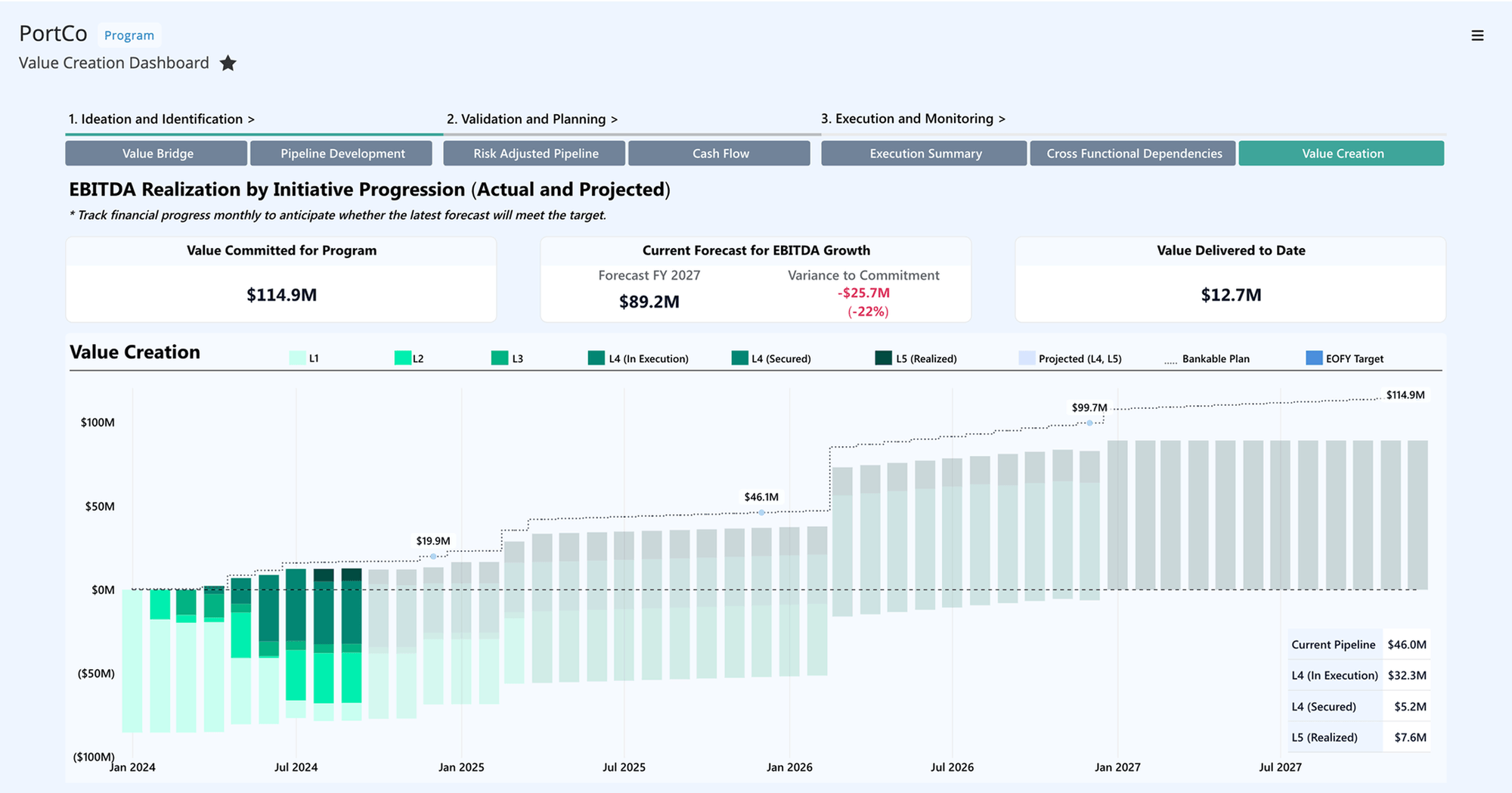
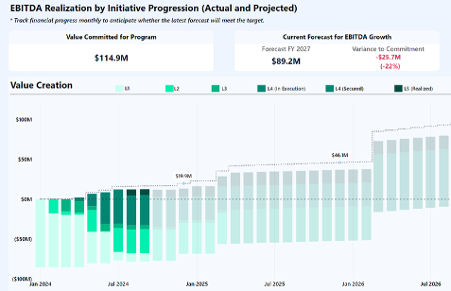
Amplify dashboard showing EBITDA realization by initiative progress
Amplify Dashboard – EBITDA realization by initiative progress.

Summary

Key Insight: CFOs are uniquely positioned to close the strategy-execution gap by combining financial discipline with execution visibility.

Challenge: Too many transformations fail because benefits are assumed, not tracked.

Solution: Embed financial baselines, unified data, and benefit realization frameworks into the execution process.

Amplify’s Role: Amplify gives CFOs and transformation leaders a shared platform to link strategy, budgets, and outcomes, turning financial intent into measurable impact.

Sources

McKinsey & Company (2022). “Why CFOs Need a Bigger Role in Business Transformations.”
McKinsey & Company(2023). “Four Dos and Don’ts for CFOs Leading Transformations.”
(Referenced for data points and thematic context. Full citations available on request.)