

AI Isn’t Replacing Enterprise Transformation – But It Will Redesign How It Works
The question everyone is asking — and getting wrong
There’s a question that’s coming up in almost every conversation I’m having right now, whether that’s with prospects, existing customers, or transformation leaders who are trying to work out how AI fits into what they’re doing.
It’s usually framed in a fairly direct way:
What is the value of the transformation office in the AI age?
It’s a fair question, and you can understand why people are asking it. Transformation teams are under more pressure than ever. Expectations are increasing, programs are getting more complex, and at the same time, resourcing is becoming more constrained.
But it’s also the wrong question.
Because the underlying issue most organizations are dealing with isn’t whether they have the right strategy or even the right ideas. In most cases, they do. The issue is whether they have the capacity to turn those ideas into something that actually delivers value.
One of our customers summed it up better than I could. He said, “I need a team of ten in my transformation office. I’ll probably get two.” That gap between ambition and capacity is where most transformations start to slow down.
The real constraint isn’t a clear strategy, it’s execution capacity
When you look more closely at how transformation actually plays out inside organizations, a pattern emerges quite quickly.
Strategy is rarely the problem. The thinking is often sound, the priorities are clear, and the intent is there. Where things start to break down is in the ability to execute consistently and at scale.
Initiative owners don’t always get the support they need to shape ideas properly. Transformation teams become stretched across too many priorities. Processes that should take days extend into weeks because they rely on a small number of experienced individuals who quickly become bottlenecks.
It’s not unusual to see it take eight to twelve weeks to move from an initial idea to something that is fully defined, validated, and ready to move forward. Not because the work itself is inherently complex, but because the system around it is slow, manual, and capacity-constrained.
That’s the constraint. And it’s exactly where AI starts to become meaningful.
The real role of AI: removing friction, not replacing judgment
There’s a lot of noise at the moment about AI replacing jobs, and in the context of transformation, that conversation tends to focus on whether parts of the transformation office can be automated.
From what we’ve seen, that framing misses the point.
The parts of transformation that actually determine outcomes — judgment, trade-offs, accountability — are not things you can or should automate away. Transformation is not purely analytical. It depends on context, experience, and the ability to make decisions under uncertainty.
At the same time, a significant portion of the work that surrounds those decisions is repetitive, time-consuming, and often frustrating for the people doing it.
Structuring business cases, gathering and validating data, following up on updates, ensuring governance requirements are met — all of this work is necessary, and it often requires skilled people. But it is also repeatable.
That distinction matters.
Because repeatable work is where AI can create real leverage. Not by replacing people, but by removing friction from the system they operate within.
Why the model is shifting: from capability gaps to embedded guidance
When we first built Amplify, our assumption was that transformation offices were relatively mature. That they had experienced teams, well-defined processes, and what they needed was better tooling to connect everything together.
What we’ve seen over time is a different reality.
There are fewer experienced transformation leaders than many organizations assume, and at the same time, the number of transformation programs has increased significantly. The result is a capability gap. Organizations are trying to run increasingly complex programs without the depth or capacity to support them properly.
That’s why the conversation has shifted.
Customers are no longer just asking for software. They’re asking for guidance. They want structure. They want to know that the way initiatives are being defined, governed, and executed reflects best practice.
Increasingly, they’re asking whether that guidance can be embedded directly into the system, rather than relying on a small number of individuals to provide it manually.
From tooling to embedded intelligence
At Amplify, that shift is shaping how we’re approaching AI.
We’re not interested in adding AI as a layer on top of existing workflows or introducing features for the sake of it. The focus is on where intelligence can genuinely improve how execution happens.
In practical terms, that means embedding intelligence into the process itself. Instead of asking people to complete forms and then validating them later, the system can guide them as they work. Our agents are designed to help structure thinking, challenge assumptions, and ensure that key requirements are met at the point of entry.
The effect of that is not just speed, although that matters. It’s also consistency. It’s data quality. It’s reducing the reliance on already stretched transformation teams to catch issues after the fact.
We’re taking a similar approach more broadly, thinking about how different parts of the transformation office can be supported by purpose-built capabilities that work alongside people, rather than replacing them. It’s an area we’re investing in heavily, but deliberately, with a focus on where it adds real value rather than where it simply sounds compelling.
How we think about AI in transformation
At a practical level, the way we think about AI in transformation is not as a feature or a capability, but as part of a system.
We see transformation as a continuous loop that connects four things: data, judgment, recommendations, and decisions. Each of these depends on the others. Better data leads to better judgment. Better judgment leads to better decisions. Better decisions generate better data.
It’s not a linear process. It’s a cycle.
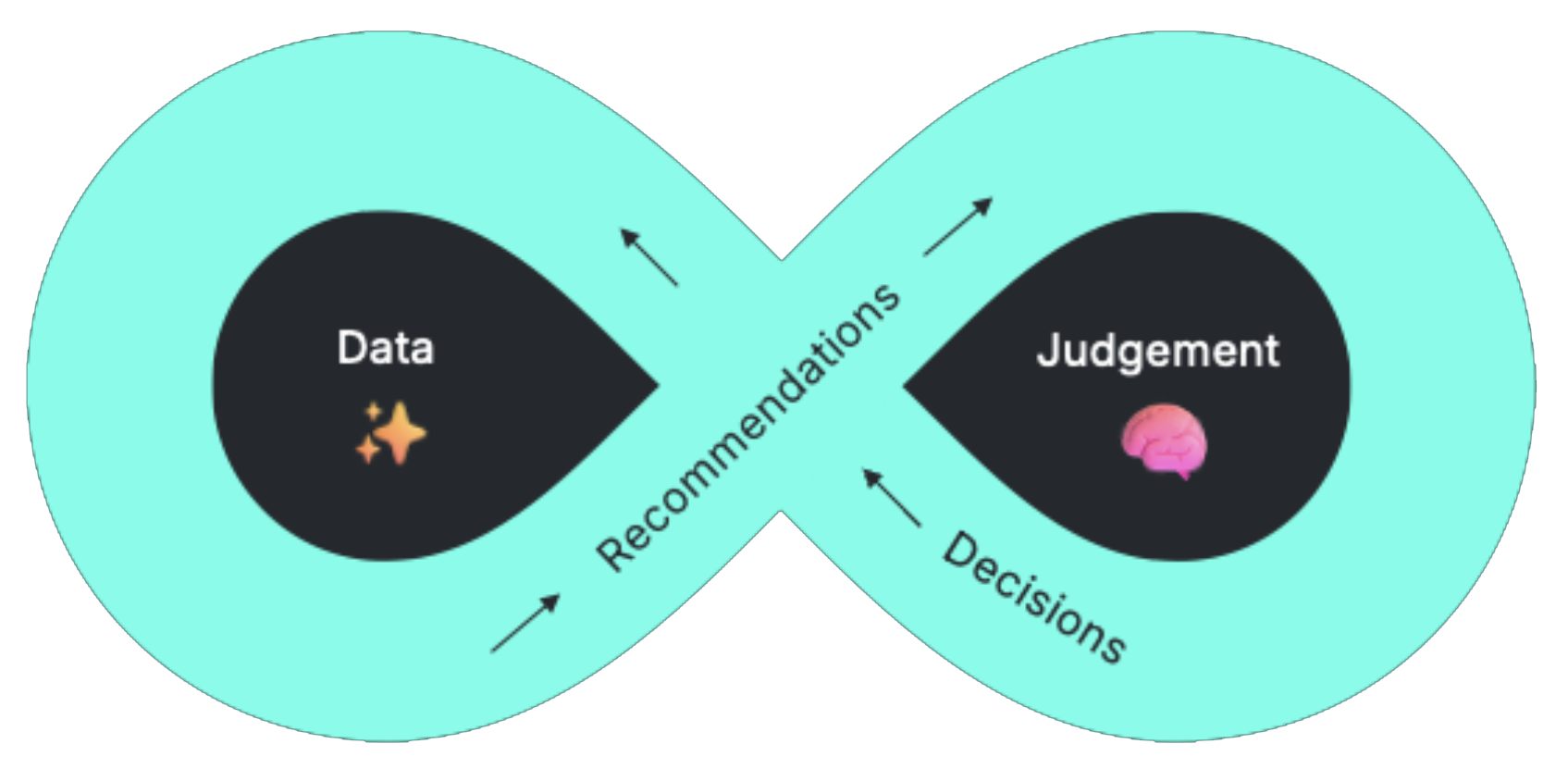
AI strengthens parts of this loop. It improves the quality and availability of data, and it accelerates the generation of insight and recommendations.
But it doesn’t replace the need for judgment, and it doesn’t remove accountability for decisions.
Those are the points in the loop where context, experience, and trade-offs matter most. They’re also the points where transformation succeeds or fails.
So rather than trying to take people out of the process, the goal is to strengthen the loop itself — using AI to improve the flow from data through to decisions, while keeping humans firmly responsible for the outcomes.
Why context matters more than capability
One of the most useful pieces of feedback we’ve had recently came from a customer who said that none of this works unless the system understands how they operate.
Their stage gates, their financial principles, their definitions of value — these things vary between organizations, and they matter. Without that context, even the most capable AI will produce outputs that are technically correct but practically unhelpful.
That’s the difference between generic AI and applied AI.
Generic AI can generate answers. Applied AI needs to reflect the operating model of the organization it sits within. In transformation, where governance, value, and accountability are tightly defined, that context is not optional. It’s fundamental.
What a modern transformation office looks like
If you follow this through, the implication is not that transformation offices disappear, but that they change.
The traditional model is heavily dependent on people and can be difficult to scale. As programs grow in size and complexity, the demand for support grows with them.
A more modern approach is leaner and more intelligent. Systems take on more of the coordination, data handling, and repeatable work, while people focus on prioritization, trade-offs, and leadership.
The practical impact of that is significant. Planning cycles shorten. Data quality improves. Governance becomes more consistent. And teams are able to support larger programs without a linear increase in headcount.
The shift that matters
AI will change transformation. That’s already happening.
But the organizations that benefit most won’t be the ones that rush to automate everything or layer AI onto existing processes.
They’ll be the ones that take a step back and rethink how execution actually works. Where the friction is. Where capacity is being consumed. And where intelligence can genuinely improve the system.
Because this isn’t about adding AI into transformation, it’s about redesigning how transformation is executed.
And that’s a much bigger shift.
Explore how modern transformation teams are redesigning execution →
