
Resource Planning That Works at Enterprise Scale
A closer look at how Amplify’s enhanced Resource Management supports portfolio-level execution
What this article covers
- Why resource planning becomes a constraint as transformation scales
- How mature Transformation Offices manage capacity, demand, and allocation at the portfolio level
- How Amplify supports disciplined, initiative-led resource planning — from planning through execution
- Where task management fits as the final step in a broader execution capability
Who it’s for
Transformation Office leaders, EPMO leaders, program and project managers, and power users responsible for coordinating delivery across portfolios of initiatives.
Why Resource Planning Still Trips Up Enterprise Transformation
For Transformation Offices and EPMOs, resource planning is rarely the headline issue — but it often determines whether strategy actually gets delivered.
Less mature organizations manage resources at the project level.
More mature organizations treat resource planning as a portfolio discipline — one that makes trade-offs explicit rather than implicit.
Most organizations struggle to:
- Understand true capacity to deliver, which changes over time
- Compare demand across initiatives against that capacity
- Make deliberate trade-offs when demand exceeds supply
- Maintain a single source of truth as work moves from planning into delivery
As transformation becomes business as usual, resource planning can no longer be reactive or informal. It must support repeatable, credible execution
Resource Planning as an Execution Discipline — Not a Scheduling Exercise
Effective resource planning follows a clear progression:
- Understand capacity
Capacity is rarely static. Workforce plans, assumptions, and constraints evolve over time. - Define demand
During initiative planning, teams define how much of a resource is required over time — not named individuals. - Compare demand vs capacity
Demand across initiatives is aggregated and reviewed at the portfolio level, revealing pressure points and conflicts. - Make trade-offs
Leaders prioritize which initiatives are resourced first, and which must wait or change. - Allocate resources
Resources are allocated to initiatives in line with approved priorities. - Assign and execute
Project managers assign allocated resources to tasks and delivery begins. - Learn and improve
Planned demand is compared to actual usage, improving future estimates and decision quality.
This progression reflects an operating discipline, not a one-time plan.
Resource Management in Amplify: Designed for Portfolio-Level Execution
Amplify’s resource management capability exists to support one core outcome:
Clear, governed alignment between organizational capacity and initiative demand.
Rather than treating resourcing as a downstream task-management activity, Amplify enables organizations to:
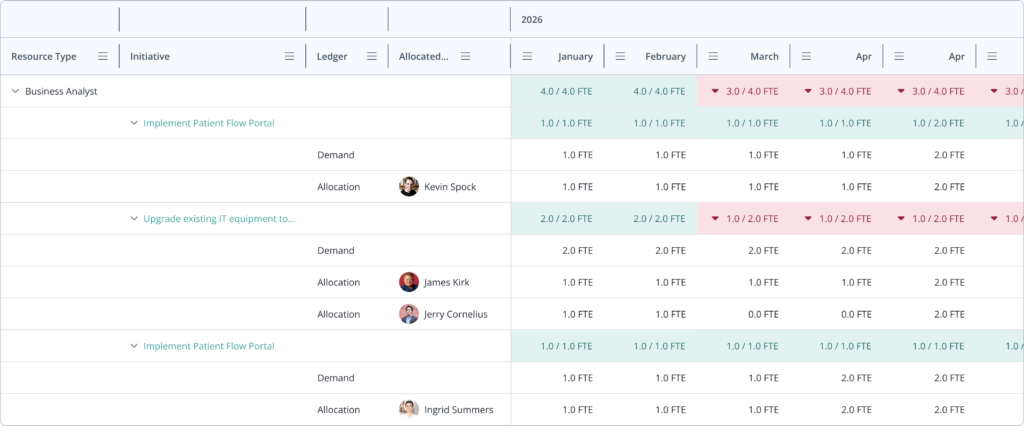
- Define demand at the initiative level
- Review demand across the portfolio
- Allocate resources centrally
- Maintain alignment as initiatives move into execution
This is especially relevant for Transformation Offices and EPMOs responsible for balancing competing priorities over time.
What’s Been Enhanced — Without Changing How Teams Already Work
Resource management has long existed within Amplify. The latest enhancements strengthen the structure, clarity, and governance required as organizations mature.
1. Standardized Resource Classification
Resources are managed through standardized resource classifications, creating a consistent language for delivery capacity.
This allows organizations to:
- Define delivery resource categories once
- Reuse them across initiatives
- Separate resource classifications from user roles and permissions
The distinction matters:
- Resources represent delivery capacity
- Roles determine access, permissions, and workflow notifications
This clarity supports more consistent planning and portfolio visibility.
2. Demand Definition Over Time — Before Assignment
Project and program managers can define resource demand over time without assigning named individuals.
This supports:
- Early-stage planning without premature staffing
- Rolling-wave refinement as initiatives progress
- More reliable portfolio-level demand signals
Demand becomes an input to portfolio decisions — not an afterthought.
3. Centralized Allocation as a Single Source of Truth
Transformation Offices and EPMOs allocate resources to initiatives to meet approved demand.
By separating allocation from task assignment, Amplify ensures:
- Allocations reflect organizational commitments
- Execution aligns with portfolio decisions
- Leaders can see where capacity has been committed — not just where tasks exist
This strengthens accountability and execution credibility.
4. Adaptive Governance Through Structured Workflows
Resource allocation decisions can follow structured approval workflows, routed to the appropriate permission-based roles or departments.
This enables:
- Clear accountability
- Transparent decision-making
- Governance that scales with complexity rather than slowing delivery
It’s governance designed to support execution, not obstruct it.
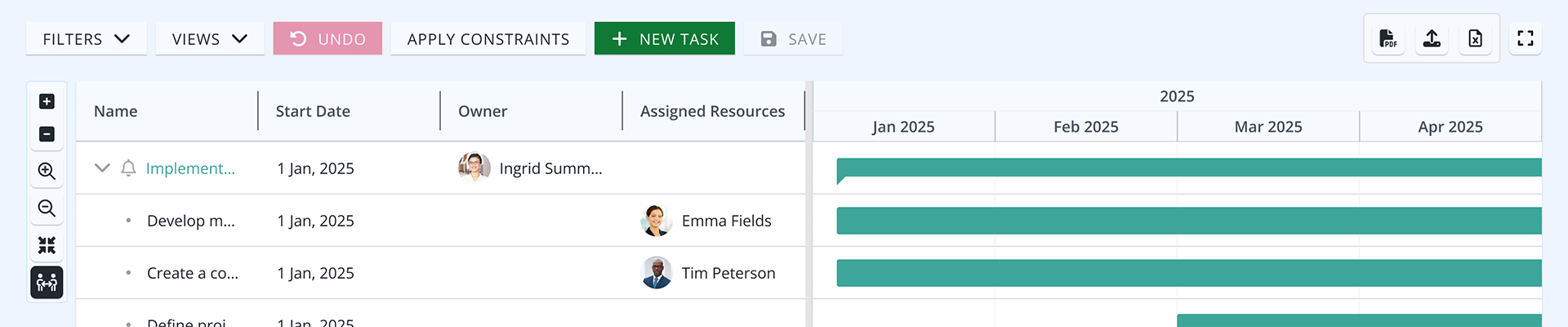
5. Task Assignment and Learning — Closing the Loop
Task management is the final step, not the foundation.
Once resources are allocated:
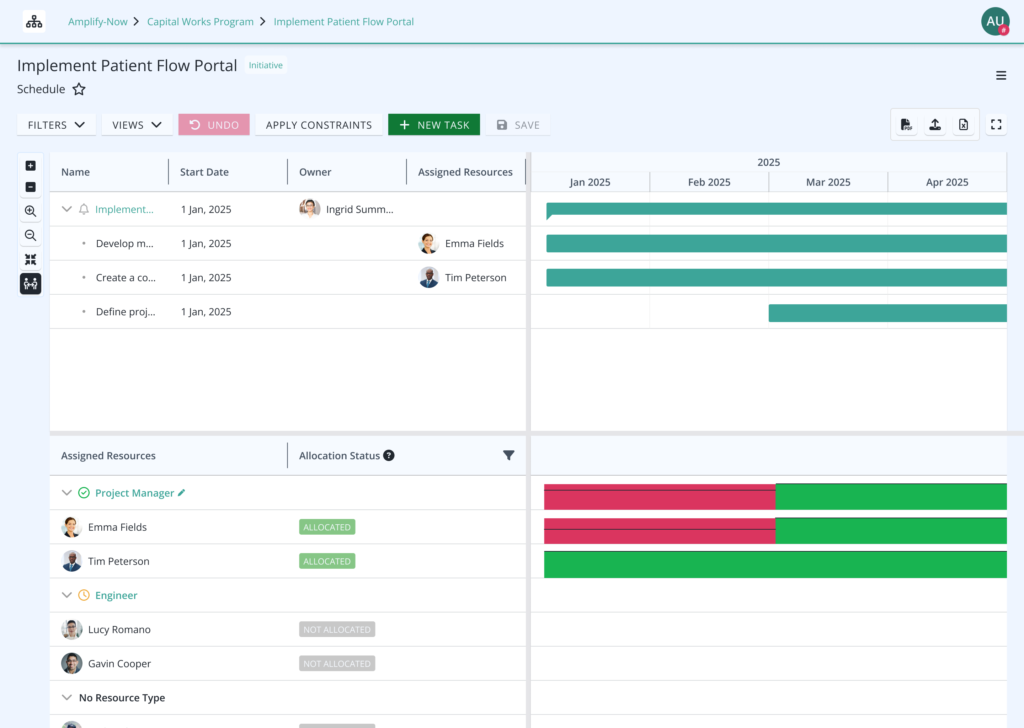
- Project managers assign allocated resources to tasks
- Delivery progresses
- Actual usage can be reviewed against planned demand
Over time, this creates a learning loop — improving estimate accuracy and strengthening execution discipline.
Why This Matters for Transformation Offices and EPMOs
Mature resource planning directly supports:
Better Decisions
Trade-offs are explicit, evidence-based, and portfolio-wide.
Stronger Governance
Allocations reflect approved priorities, not just activity.
More Credible Execution
Delivery aligns with what the organization has actually resourced.
Designed for Evolving Levels of Operating Maturity
Amplify supports organizations operating at different levels of execution maturity:
- From early demand definition
- To portfolio-level allocation
- To continuous improvement over time
The goal isn’t complexity for its own sake — it’s disciplined execution that scales.
Who Is This Most Useful For?
- Transformation Office leaders overseeing enterprise-wide change
- EPMO leaders managing capacity, demand, and prioritization
- Program and project managers planning and delivering initiatives
- Power users configuring governance and planning standards
Especially where resources are shared and priorities evolve.
A Stronger Foundation for Ongoing Execution
Enhanced resource management strengthens Amplify’s broader execution foundation by supporting:
- Portfolio prioritization
- Adaptive governance
- Rolling-wave planning
- Continuous improvement in delivery accuracy
All without forcing teams to change how they already work.
Want to see how disciplined resource planning works in practice?
Explore how Amplify supports portfolio-level execution.
